business
Who Really Holds America’s Private Debt Risk?
The Federal Reserve’s October 2026 accounting changes reveal more of America’s $2.6 trillion private-credit market—and raise new questions about leverage, transparency, investor exposure and financial stability.






America’s private-credit market has a visibility problem that is only beginning to be resolved. For years, investment funds have increasingly financed businesses through privately negotiated loans, bypassing the conventional banking system and public bond markets. The arrangement has offered borrowers an alternative source of capital and investors an opportunity to earn income from loans that are difficult to buy or sell on public markets. Yet the same characteristics that make private credit attractive also complicate the measurement of leverage, the valuation of distressed assets and the identification of risks spreading between financial institutions.
On October 16, 2026, the Federal Reserve Board published a significant step toward closing that information gap. In a research note titled “Introducing Private Credit into the Financial Accounts of the United States,” eight Federal Reserve economists explained how private-credit vehicles and their lending activities had been incorporated into the Financial Accounts of the United States, commonly known as the Z.1 accounts.
The change matters for more than statistical completeness. It makes it easier to follow the chain connecting investors, lending funds and borrowing companies. That chain is central to understanding whether private credit genuinely diversifies the American financial system or relocates credit risk into institutions and investment structures that are harder to monitor.
A market measured in trillions, but not by a single definition
The Federal Reserve’s new estimates illustrate the scale of the transformation. Katie Brinkman, Christine Dobridge, Tim Dore, Simon Glossner, Elizabeth Holmquist, Nam Nguyen, Maria Perozek and Irina Stefanescu report that financial assets held by private-credit vehicles increased from approximately $350 billion in 2012 to more than $2.6 trillion in the fourth quarter of 2025. Outstanding private-credit loans to US businesses stood at approximately $1.5 trillion.
These figures describe different things. The $2.6 trillion figure measures the financial assets of the relevant private-credit vehicles, while the $1.5 trillion figure measures outstanding loans to US businesses. They should not be treated as interchangeable estimates of the same market. The Federal Reserve also identifies approximately $1.1 trillion in private-credit loan activity attributable to US-domiciled vehicles in its methodological discussion. That narrower figure reflects a different institutional scope, rather than contradicting the broader estimate.
The distinctions are important because private credit is not one homogeneous pool of loans. It includes private debt funds, business development companies (BDCs), interval and tender-offer funds, and middle-market collateralized loan obligations (MM CLOs). Some vehicles are domiciled outside the United States, while their loans may finance American businesses. Others use distinct legal and financing arrangements that affect how assets, liabilities and investor claims should be recorded.
For readers trying to understand the financial system, the lesson is immediate: market size depends on what is being counted, where the lender is domiciled, whether the statistic measures assets or loans, and how financing vehicles are consolidated or classified. A headline market valuation without these distinctions can obscure rather than explain the distribution of risk.
What the Federal Reserve could not previously see clearly
The Financial Accounts provide a comprehensive framework for tracking financial assets and liabilities across the US economy. Before the new integration, much of the lending by domestic private-credit vehicles was already reflected as liabilities on nonfinancial corporate business balance sheets. However, the loans were generally not separately identified as a distinct debt instrument, and the intermediation activities of private-credit vehicles were largely missing as identifiable sectors.
This created an analytical blind spot. A company's borrowing could appear in aggregate business-debt statistics without researchers being able to distinguish the portion financed by a private debt fund from other forms of credit. Meanwhile, the fund's assets, financing and investor claims were not necessarily visible as a complete, connected chain within the same statistical framework.
The October note describes how the Federal Reserve used confidential Securities and Exchange Commission Form PF information alongside other data sources to construct balance sheets for private-credit funds and related vehicles. Beginning with the September 2026 Financial Accounts release, the framework includes three new sectors for US-domiciled private debt funds, BDCs, and interval and tender-offer funds. It also adds instrument categories for private-credit loans and shares of private debt funds. Domestic middle-market CLOs are represented in the asset-backed securities sector, with their loans recorded as assets and their issued debt recorded as corporate-bond liabilities.
The result is a more complete map of who lends, who borrows and who ultimately holds financial claims. The Federal Reserve says the integration improves the measurement of nonfinancial-business leverage, household balance sheets and exposures to private-credit markets. It also makes it easier to investigate how credit risk connects different sectors rather than studying lenders and borrowers in isolation.
But a better map is not the same as a real-time warning system. Financial Accounts are comprehensive national balance-sheet statistics, not a live register of every loan's covenant, collateral value, repayment schedule or current probability of default. Their usefulness depends on the quality, coverage and timeliness of the underlying data, as well as the analytical work needed to interpret them.
The problem with treating private credit as one market
Private credit is often discussed as though every loan were a direct agreement between an investment fund and a middle-market company. In practice, the structure can be considerably more complicated. A private debt fund may originate or hold loans, a BDC may offer investors exposure to a portfolio of business loans, and an MM CLO may finance loan holdings through securities with different levels of priority. Interval and tender-offer funds introduce their own arrangements for investors seeking periodic opportunities to exit.
These structures matter because the borrower, the legal owner of a loan, the fund financing it and the investor ultimately exposed to losses may be different entities. A loss at the borrower level does not necessarily translate into an immediate loss of the same size for every investor. The effect depends on the structure of the financing, the order in which losses are absorbed, the amount of leverage, and the terms governing distributions and withdrawals.
Nor does the absence of daily trading necessarily make an investment safer. A privately negotiated loan can be held for years without the market-price fluctuations seen in a publicly traded bond. That may reduce pressure to respond to short-term market movements, but it also means that prices can be less informative when a borrower's financial condition deteriorates. Valuations may rely on models, comparable transactions and manager assessments rather than frequent arm's-length trades.
This is not proof that private-credit valuations are systematically wrong. Loans are not identical, and public-market prices can become volatile or temporarily disconnected from expected long-term repayment values. The concern is that the absence of continuous market pricing can make it harder for outside observers to distinguish a stable asset from one whose reported value has yet to reflect worsening credit conditions.
The Federal Reserve's new sectoral accounting can reveal more about the scale and location of exposures. It cannot, by itself, establish whether a particular portfolio's valuations are prudent or whether a borrower has sufficient cash flow to service its debt.
How private credit differs from bank loans and public bonds
Traditional banks generally fund lending through deposits and wholesale borrowing, subject to capital, liquidity and supervisory requirements. Banks can maintain relationships with borrowers over time and may restructure loans when businesses experience temporary difficulties. However, their reliance on deposit funding can create liquidity pressures if depositors withdraw money quickly, while regulatory capital requirements influence their willingness to extend credit.
Public corporate bonds operate differently. Issuers can raise large amounts of capital from investors, and securities may trade in liquid markets where prices adjust to new information. That transparency can help investors compare credit risk, although liquidity can deteriorate during market stress and smaller businesses may find public issuance too expensive or impractical.
Private-credit lenders occupy a different position. They can negotiate bespoke financing, provide relatively rapid execution, and lend to companies that may be too small or complex for public bond markets. Loan agreements can be tailored to an acquisition, refinancing or expansion. For borrowers, the value may lie not simply in the interest rate but also in execution certainty and the ability to negotiate directly with a lender.
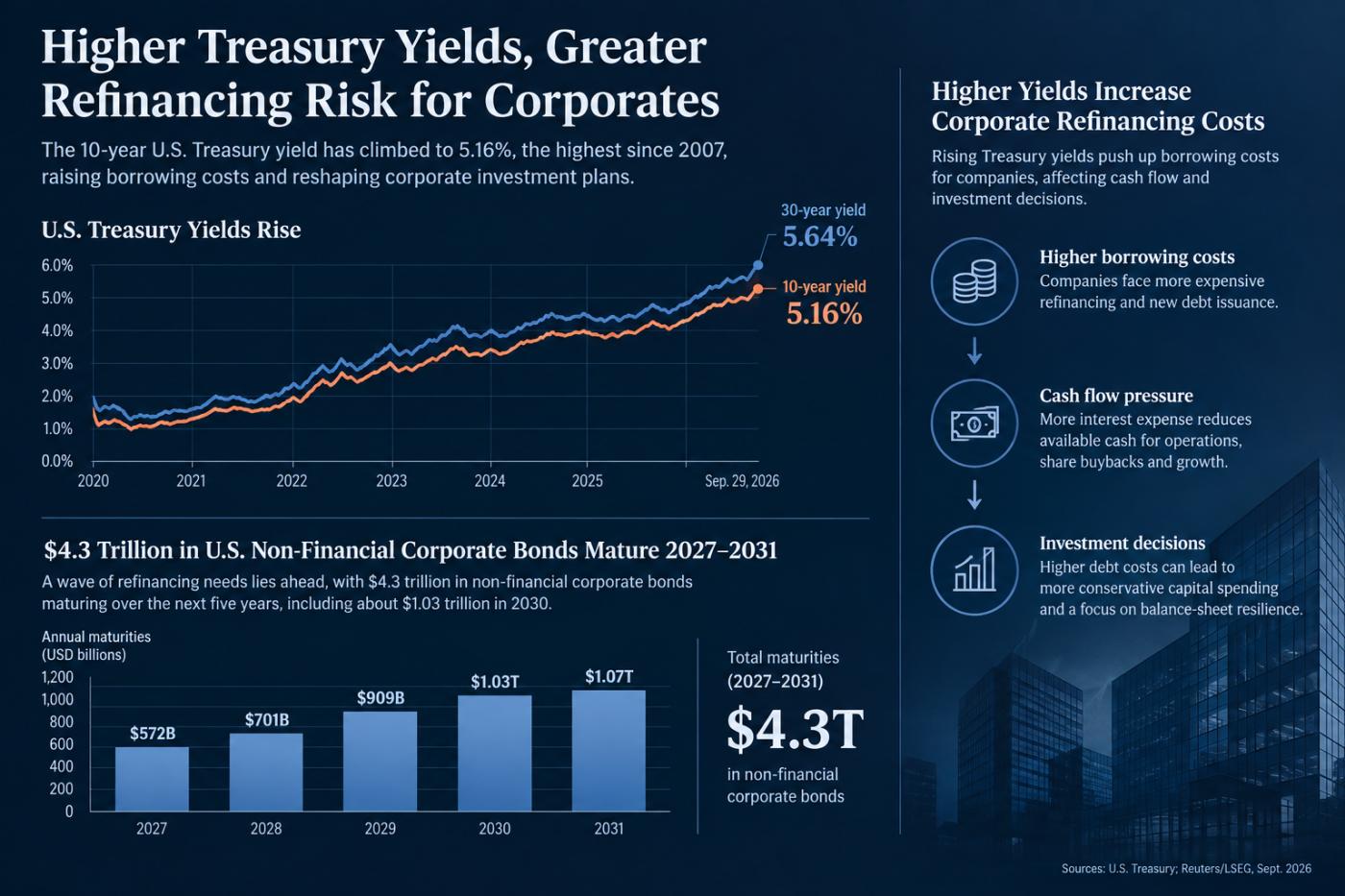
However, private loans commonly have floating interest rates. When benchmark rates rise, borrowers may face higher debt-service costs unless hedging arrangements or contract terms mitigate the increase. Lenders may benefit initially from higher interest income, but that benefit can be offset if borrowers struggle to pay. A prolonged period of expensive credit can therefore turn an apparent yield advantage into a growing risk of defaults, restructurings or lower recoveries.
Private credit does not eliminate banking-system risk, either. Banks may provide credit facilities to funds, finance subscription commitments, lend to BDCs or supply other services to investment vehicles. These links mean that a loss originating in a nonbank loan portfolio can affect a regulated bank indirectly. The extent of the exposure depends on individual contracts and counterparties; it cannot be inferred merely from the total size of the private-credit market.
Why the data architecture matters for financial stability
Financial stability analysis is fundamentally about connections. A lender's losses may be manageable when considered alone but become more consequential if several institutions share similar exposures, rely on the same funding sources or respond to stress by selling assets at the same time.
Private credit creates several questions for supervisors. Are different funds lending to the same industries or borrowers? How much borrowing sits at the fund level rather than the operating-company level? What obligations do funds have to return capital to investors, and how do those obligations compare with the liquidity of their loans? How much risk is shared with banks, insurers, pension funds and other institutional investors?
The Federal Reserve's integration helps researchers examine these relationships at an aggregate level. It also offers a way to assess business leverage more accurately when lending migrates from banks or public markets to nonbank funds. Without a distinct category for private-credit loans, a change in the composition of financing can be mistaken for a change in the amount or distribution of debt.
Yet aggregate accounting does not reveal every concentration. Two funds with similar assets may have very different exposures: one might lend to a broad range of established businesses, while another may be heavily exposed to a narrow industry or a handful of borrowers. Both could look similar in a high-level balance-sheet table even though their resilience to a particular shock differs sharply.
This is where supervisory reporting becomes important. Form PF, administered by the SEC and the Commodity Futures Trading Commission for covered private-fund advisers, is one source of information about private funds. But the reporting framework is not a universal, public, loan-by-loan disclosure system. The SEC's Form PF regulatory materials also show that compliance dates for previously adopted amendments have been extended, with the relevant changes scheduled to take effect on July 1, 2027. That timetable illustrates that improvements in data coverage and reporting are an ongoing process, not a problem solved by a single statistical release.
There is a tension here. More granular information can help regulators identify common exposures and emerging vulnerabilities, but private funds also argue that their strategies, portfolio details and commercial negotiations are sensitive. The policy challenge is to make data useful for systemic-risk monitoring without assuming that every detail must be disclosed publicly or that greater reporting alone will prevent losses.
What a prolonged high-rate environment could expose
The most revealing stress test for private credit may not be a sudden market crash. It may be a prolonged period in which borrowers must refinance, service floating-rate debt and maintain investment while operating margins remain under pressure.
Consider a hypothetical middle-market company that borrowed to finance an acquisition when revenue growth and refinancing conditions looked favorable. If its interest costs rise while sales weaken, less cash remains for wages, capital expenditure and debt repayment. A company can initially respond by cutting discretionary spending, selling assets or renegotiating terms. If those measures fail, a lender may need to extend maturities, amend covenants or accept a restructuring. This is a scenario, not a claim that all private-credit borrowers are currently in distress.
Such a scenario can affect several groups differently. Borrowers with stable recurring revenue and modest leverage may be able to absorb higher costs. Highly leveraged businesses, companies with weak pricing power, and firms dependent on frequent refinancing may have less room to maneuver. Lenders with diversified portfolios and conservative underwriting may absorb individual defaults, while concentrated portfolios or vehicles using additional leverage may be more sensitive to correlated losses.
Investors face another distinction: the economic performance of a loan portfolio is not identical to the liquidity of the fund through which they own it. A fund can hold loans that continue to pay interest yet still face pressure if investors seek cash faster than the fund can realize assets. Fund terms vary, and private-credit vehicles are not all subject to the same redemption arrangements. The point is not that every vehicle faces a run, but that the mismatch between asset liquidity and investor expectations needs to be assessed at the level of the specific structure.
Insurance companies and retirement investors also warrant attention because they can have long-term liabilities and may invest through multiple funds or mandates. Long investment horizons can make illiquid loans a reasonable portfolio component. The risk emerges when exposure is misunderstood, correlated across institutions, or accompanied by liquidity commitments that are difficult to honor under stress.
These pathways illustrate why measuring the total volume of private credit is only the first step. A useful stress test must examine borrower cash flows, maturity schedules, collateral recoveries, fund-level leverage, investor withdrawal provisions and links to banks and insurers. It should also distinguish between a temporary fall in reported asset values and losses that permanently impair repayment capacity.
The counterargument: private credit can make finance more resilient
Warnings about opacity should not obscure the benefits of a financing channel that has expanded partly because conventional lending is not suitable for every company. Private lenders may be able to evaluate borrowers using detailed information, negotiate tailored covenants and maintain a direct relationship with management. Long-term fund capital can reduce dependence on daily market sentiment, while a broader range of lenders can give businesses alternatives when banks tighten credit.
These advantages can support investment and employment, especially for firms that would otherwise struggle to finance acquisitions, technology upgrades or expansion. Private loans can also spread credit exposure across a wider set of investors rather than concentrating all business lending on bank balance sheets. Whether this diversification actually reduces systemic risk depends on the underlying portfolios and financing links, not on the lender's nonbank label.
Nor should the absence of public trading automatically be equated with weak underwriting. Private lenders can possess meaningful borrower-specific information, and the stability of long-term capital can allow them to work through temporary distress rather than sell into a falling market. Public debt markets, meanwhile, are not immune to leverage, concentration or sudden liquidity disruptions.
The key question is therefore not whether private credit is inherently safer or more dangerous than bank lending. It is whether risks are being priced, monitored and absorbed by institutions equipped to manage them, and whether authorities can see the connections before a localized problem becomes a broader shock.
What the new numbers still cannot tell us
The Federal Reserve's October release is an important improvement because it makes previously obscured parts of the financial intermediation chain more visible within a consistent national accounting framework. But the new estimates should be read with their definitions and methodological limits in mind. They combine confidential reporting and other sources, cover specific categories of vehicles, and distinguish US-domiciled lenders from foreign vehicles that may also finance US borrowers.
The published aggregate tables also do not provide every detail needed to map individual loans to their ultimate risk holders. The Federal Reserve notes that more detailed “from-whom-to-whom” allocations are available through its Data Download Program and the Federal Reserve Bank of St. Louis's FRED, even though they are not all shown in the standard published Z.1 tables. That is a useful starting point for researchers seeking to quantify the distribution of exposures rather than rely on headline market totals.
For businesses, the implications are practical. A larger nonbank lending market may preserve access to capital when banks retreat, but companies should still assess debt-service coverage, refinancing exposure, covenant flexibility and the effect of interest-rate changes on cash flow. For investors, the central issue is not merely the advertised yield; it is how that yield compensates for credit losses, illiquidity, leverage and the structure through which the investment is held.
For regulators, the task is to connect better aggregate measurement with timely, sufficiently granular information on exposures and funding. The private-credit expansion has made the traditional distinction between bank lending and capital markets less adequate as a complete description of how businesses borrow. The new Financial Accounts categories begin to address that gap. Whether they ultimately improve early warning will depend on how effectively the data are used to test concentrations, trace cross-sector links and identify where a seemingly diversified financial system may still be vulnerable to the same underlying shock.