business
India's Savers Reshape Banking Margins
A feature on how India's depositors, becoming more financially literate and rate-sensitive, are reshaping bank profitability and financial stability, as highlighted in RBI's Financial Stability Report 2026.





India’s banking system is undergoing a subtle but profound shift one that is less about corporate boardrooms and more about ordinary households. The Reserve Bank of India’s (RBI) Financial Stability Report (FSR), June 2026 highlights two parallel trends: corporate India has deleveraged significantly, while depositors have become more assertive, reshaping the profitability dynamics of banks.
Corporate Deleveraging: A Cleaner Loan Book
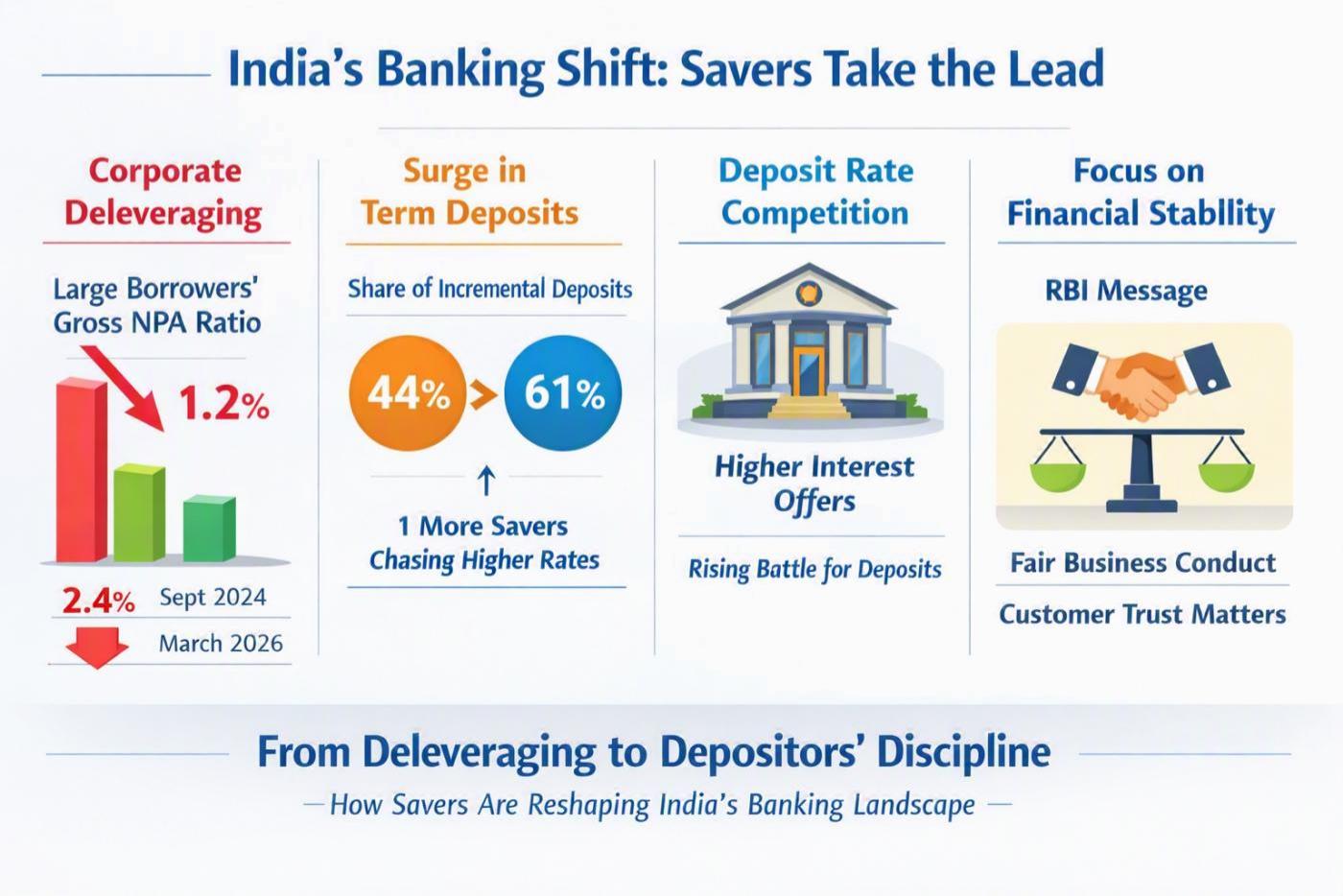
For years, the health of Indian banks was judged primarily by their exposure to large borrowers. Non-performing assets (NPAs) from corporates were the Achilles’ heel of the system. The latest FSR shows how dramatically this picture has changed. The gross NPA ratio for large borrowers fell from 2.4% in September 2024 to just 1.2% in March 2026. This halving of bad loans reflects a disciplined deleveraging by corporate India, aided by stronger cash flows, equity raising, and a more cautious approach to leverage.
As the RBI noted, “The improvement in credit quality among large borrowers has reduced systemic vulnerabilities.” This is not a small achievement: large borrowers account for nearly half of total bank credit. Their improved repayment discipline has freed up capital buffers and reduced provisioning costs, giving banks breathing room.
Depositors Take Center Stage
Yet, the FSR’s most intriguing insight lies elsewhere. Even as credit quality improves, banks are facing margin pressures from the liability side. Savers, increasingly financially literate and rate-sensitive, are shifting funds into term deposits to capture higher yields. This shift is squeezing banks’ net interest margins (NIMs), as they must pay more to retain deposits while lending rates remain competitive.
The RBI observed that “depositors are displaying heightened sensitivity to interest rate movements, leading to a reallocation toward term deposits.” In plain terms, ordinary households are no longer passive participants. They are actively shopping for better rates, forcing banks to compete harder for their savings.
Deposit Competition Intensifies
The FSR flags intensifying deposit competition among banks. With credit growth steady but not explosive, the battle for deposits has become the new frontier. Banks are rolling out innovative deposit schemes, offering higher rates on longer tenures, and even experimenting with digital-only products to attract younger savers. Margins are under pressure, but the discipline imposed by depositors is reshaping the system in ways that benefit households.
Consider the numbers: term deposits now account for over 60% of incremental deposit growth in FY2025-26, compared to less than 45% two years earlier. This rebalancing means banks must recalibrate their funding strategies. The easy era of low-cost current and savings accounts (CASA) dominating the liability mix is giving way to a more competitive environment where depositors demand fair returns.
Financial Stability: Beyond Capital Buffers
The RBI’s broader message is striking. Financial stability is no longer just about prudential capital buffers or provisioning norms. It increasingly depends on banks’ ability to demonstrate fair business conduct toward customers. As the report notes, “The resilience of the financial system is as much a function of customer trust and fair conduct as of capital adequacy.”
This is a subtle but important shift. Regulators are signaling that depositor empowerment is not a risk to be managed but a discipline to be embraced. Banks that treat customers fairly, offer transparent products, and compete responsibly for deposits will not only retain trust but also strengthen systemic stability.
The Rise of the Rate-Sensitive Saver
What makes this story offbeat is the role of ordinary depositors. For decades, the narrative around Indian banking revolved around corporate defaults, government recapitalizations, and regulatory reforms. Savers were seen as passive providers of liquidity. Today, they are quietly reshaping the system from the bottom up.
Households are more financially literate than ever. The proliferation of digital banking apps, comparison platforms, and RBI’s own push for transparency has made it easier for depositors to track rates and switch products. This rate sensitivity is not just anecdotal it is showing up in the data. The migration toward term deposits is evidence of a new discipline imposed by savers.
As one senior RBI official remarked in the FSR briefing, “The Indian depositor is becoming more discerning, and this is a healthy development for the system.”
Implications for Banks
For banks, this shift is double-edged. On one hand, improved credit quality from corporates reduces risk. On the other, deposit competition raises funding costs. The net effect is a tighter margin environment. Banks must innovate not just in lending but in deposit mobilization. This could mean more personalized deposit products, loyalty-linked rates, or integration with financial planning tools.
Importantly, banks can no longer rely on inertia. The depositor who once parked funds in a savings account without question is now actively comparing rates across institutions. This forces banks to sharpen their customer engagement strategies. In the long run, this competition could lead to better outcomes for households, with higher deposit rates and more transparent products.
A Bottom-Up Discipline
The underappreciated angle here is that depositors are imposing a bottom-up discipline on the banking system. Unlike regulatory capital requirements, which are top-down mandates, depositor behavior is organic and market-driven. It reflects a quiet empowerment of households, who are now shaping the liability side of bank balance sheets.
This discipline complements the deleveraging of corporates. Together, they create a more resilient system: cleaner loan books on the asset side, and more competitive, customer-driven funding on the liability side. The result is a banking system that is less vulnerable to shocks and more responsive to households.
Looking Ahead
The RBI’s FSR 2026 is a reminder that financial stability is multi-dimensional. Corporate deleveraging has reduced credit risk, but depositor empowerment is reshaping profitability. Banks must adapt to this new reality, where customer-facing conduct is as important as capital adequacy.
For savers, this is a positive story. Their growing financial literacy and rate sensitivity are not just personal wins they are systemic contributions. By demanding better returns and fair conduct, depositors are quietly strengthening the foundations of India’s banking system.
In a sector where headlines often focus on corporate defaults or regulatory interventions, the rise of the empowered depositor deserves more attention. It is a story of households reshaping finance from the ground up an offbeat but profoundly positive shift in India’s financial landscape.