business
The Homecoming of Global Indian Capital
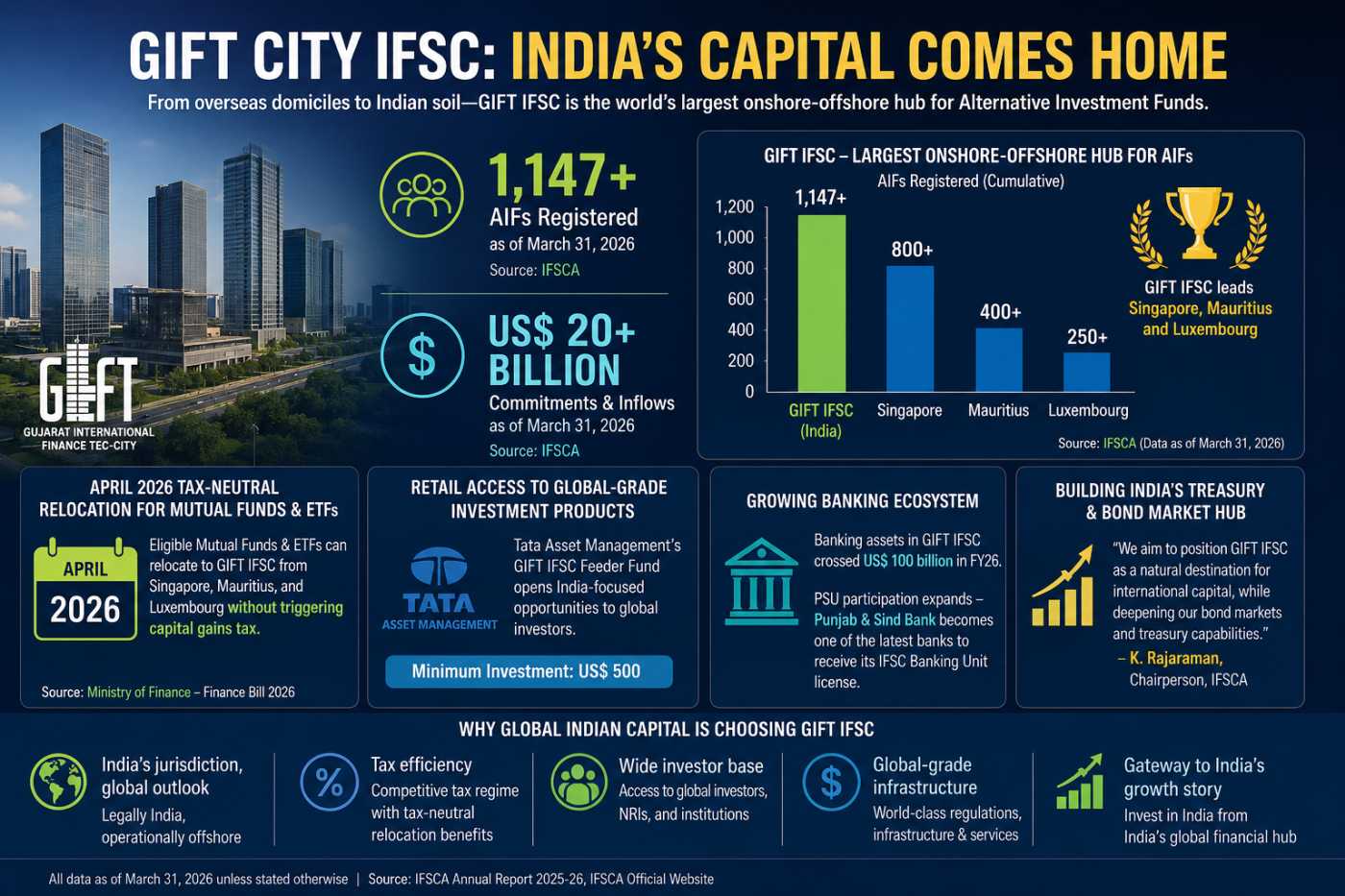
India's April 2026 tax-neutral relocation regime is transforming GIFT City into a homecoming destination for global Indian capital. With more than 1,147 fund registrations and over $20 billion in inflows, GIFT IFSC is attracting India-focused funds, NRIs, and asset managers from Singapore, Mauritius, and Luxembourg while expanding its ambitions in bond markets, treasury services, and retail investment products.





For decades, a curious paradox sat at the heart of India's financial story. Indian entrepreneurs built global businesses, Indian families accumulated wealth across continents, and India-focused investment funds often chose jurisdictions such as Singapore, Mauritius, or Luxembourg as their legal homes. Capital seeking India's growth frequently left India first before returning as investment.
In 2026, that pattern is beginning to reverse.
The most significant development is not a new stock exchange product or a headline-grabbing listing. Instead, it is a tax reform that quietly changes where India-focused capital can live. Effective from April 2026, India's relocation framework allows eligible mutual funds and exchange-traded funds (ETFs) to relocate to GIFT City IFSC without triggering capital gains tax, extending a tax-neutral relocation regime that had previously focused on alternative investment structures. According to the Finance Bill memorandum issued by the Ministry of Finance, the objective was to bring retail schemes and ETFs into the existing relocation framework for funds operating from the International Financial Services Centre.
From Capital Flight to Capital Homecoming
The significance goes far beyond tax administration.
For nearly three decades, Singapore and Mauritius emerged as preferred domiciles for India-focused funds because they offered regulatory familiarity, international investor acceptance, and tax efficiency. The result was a financial geography in which Indian growth was often financed through vehicles legally based outside India.
GIFT City now offers a different proposition: a jurisdiction that is legally Indian, regulated by the International Financial Services Centres Authority (IFSCA), but designed to operate as an offshore financial centre with dollar-denominated products, international regulations, and cross-border capital access.
IFSCA data show that GIFT IFSC has evolved into the largest onshore-offshore hub for Alternative Investment Funds, crossing 1,147 fund registrations by March 2026 and attracting commitments and inflows exceeding $20 billion. The scale is particularly notable because it has been achieved in less than a decade, challenging structures that took Singapore and Mauritius many years to build.
The shift represents something rarely discussed in conventional GIFT City coverage: India is no longer merely trying to attract foreign capital. It is attempting to repatriate Indian-origin capital that historically preferred overseas domiciles.
A Tax Reform With Strategic Consequences
The April 2026 relocation provision may appear technical, but its implications are substantial.
The Finance Ministry's explanatory memorandum stated that retail schemes and ETFs regulated under the IFSC framework would now be included within the definition of eligible 'resultant funds,' enabling tax-neutral relocation to GIFT City. In practical terms, a fund domiciled in Singapore, Mauritius, or Luxembourg can migrate to GIFT IFSC without creating an immediate capital gains tax event for investors.
Historically, relocation often created tax friction precisely when fund managers wanted operational flexibility. Removing that friction changes the cost-benefit calculation for global asset managers with India-focused mandates.
Rather than establishing entirely new structures, managers can increasingly view GIFT City as a destination for existing vehicles and investor pools.
The Retail Investor Arrives
Perhaps the most important difference between GIFT City's first phase and its current phase is accessibility.
Earlier discussions around IFSC largely revolved around institutional investors, aircraft leasing, family offices, and alternative investment funds. Today, retail-oriented products are beginning to appear.
Tata Asset Management's GIFT IFSC feeder fund, for example, has been marketed with a minimum investment threshold of around $500. That may sound modest, but symbolically it represents a major shift. Dollar-denominated investment products operating from an offshore-style jurisdiction are no longer reserved exclusively for large institutions or ultra-high-net-worth investors.
The result is a new pathway for non-resident Indians, global Indians, and internationally mobile professionals who want exposure to India's growth story through structures operating in a globally familiar financial environment.
For many NRIs, GIFT City increasingly resembles a financial bridge rather than a separate market.
The Treasury Hub Ambition
The fund industry is only one part of a larger strategy.
IFSCA Chairperson K. Rajaraman has repeatedly emphasized the ambition to deepen bond markets and build treasury-management capabilities within GIFT City. In public remarks during 2026, Rajaraman described the IFSC's objective as positioning itself as a natural destination for international capital while expanding market depth through stronger bond-market participation, treasury operations, and global financial linkages.
That objective matters because treasury activities are often the hidden engine of major financial centres. Multinational corporations centralize liquidity management, foreign exchange operations, hedging, and funding decisions through treasury hubs. Those activities create a dense ecosystem of banks, brokers, custodians, asset managers, and service providers.
If funds represent the asset side of capital, treasury operations represent the plumbing. GIFT City's long-term competitiveness depends on attracting both.
Recent developments suggest progress. In interviews during 2026, Rajaraman highlighted rising banking assets, expanding offshore borrowing activity, and growing participation across financial-market segments.
Why PSU Banks Matter More Than They Seem
One of the most overlooked indicators of GIFT City's maturation is the participation of mid-tier public-sector banks.
When institutions such as Punjab & Sind Bank obtain their first IFSC Banking Unit licenses, the development may not attract major headlines. Yet it signals that GIFT City is moving beyond an ecosystem dominated by global banks and a handful of large domestic institutions.
Financial centres become durable when participation broadens across the banking system rather than remaining concentrated among elite players.
The expansion of IFSC Banking Units has already produced visible results. Banking assets within GIFT IFSC crossed the $100 billion mark during FY26, supported by increasing participation from both domestic and international lenders. The ecosystem now includes global banks, Indian private-sector institutions, and public-sector lenders operating within a common offshore-style framework.
A Different Kind of Financial Nationalism
There is an unusual aspect to GIFT City's evolution. Unlike traditional financial nationalism, which often focuses on restricting capital movement, GIFT City's model depends on making India more open to global capital flows.
The strategy is not to force money home. It is to create a jurisdiction attractive enough that capital chooses to return.
That distinction helps explain why the relocation framework matters. Investors are not being asked to sacrifice global standards or international flexibility. Instead, they are being offered a platform where those characteristics coexist with an Indian legal domicile.
In many ways, GIFT City's emerging role mirrors a broader trend across the Indian economy. Manufacturing policy seeks to bring supply chains closer to home. Technology policy aims to localize digital infrastructure. Financial policy is increasingly trying to localize capital domiciliation.
The result is a subtle but important shift. For years, India exported capital structures and imported investment flows. GIFT City is attempting to keep both under one roof.
If the experiment succeeds, future India-focused funds may no longer need a stopover in Singapore or Mauritius before investing in India. They may be able to begin, operate, and scale directly from an offshore platform located on Indian soil.
That is why the April 2026 relocation provision deserves attention. It is not merely a tax amendment. It is part of a broader effort to reverse a decades-old financial migration pattern and position GIFT City as the place where global Indian capital finally comes home.