business
The $4.3 Trillion Refinancing Wall Facing US Companies
The 10-year US Treasury yield has returned to 5.16%, creating a new challenge for corporate borrowers. With $4.3 trillion of US non-financial corporate bonds maturing between 2027 and 2031, higher refinancing costs could gradually reshape investment, capital allocation and balance-sheet resilience.





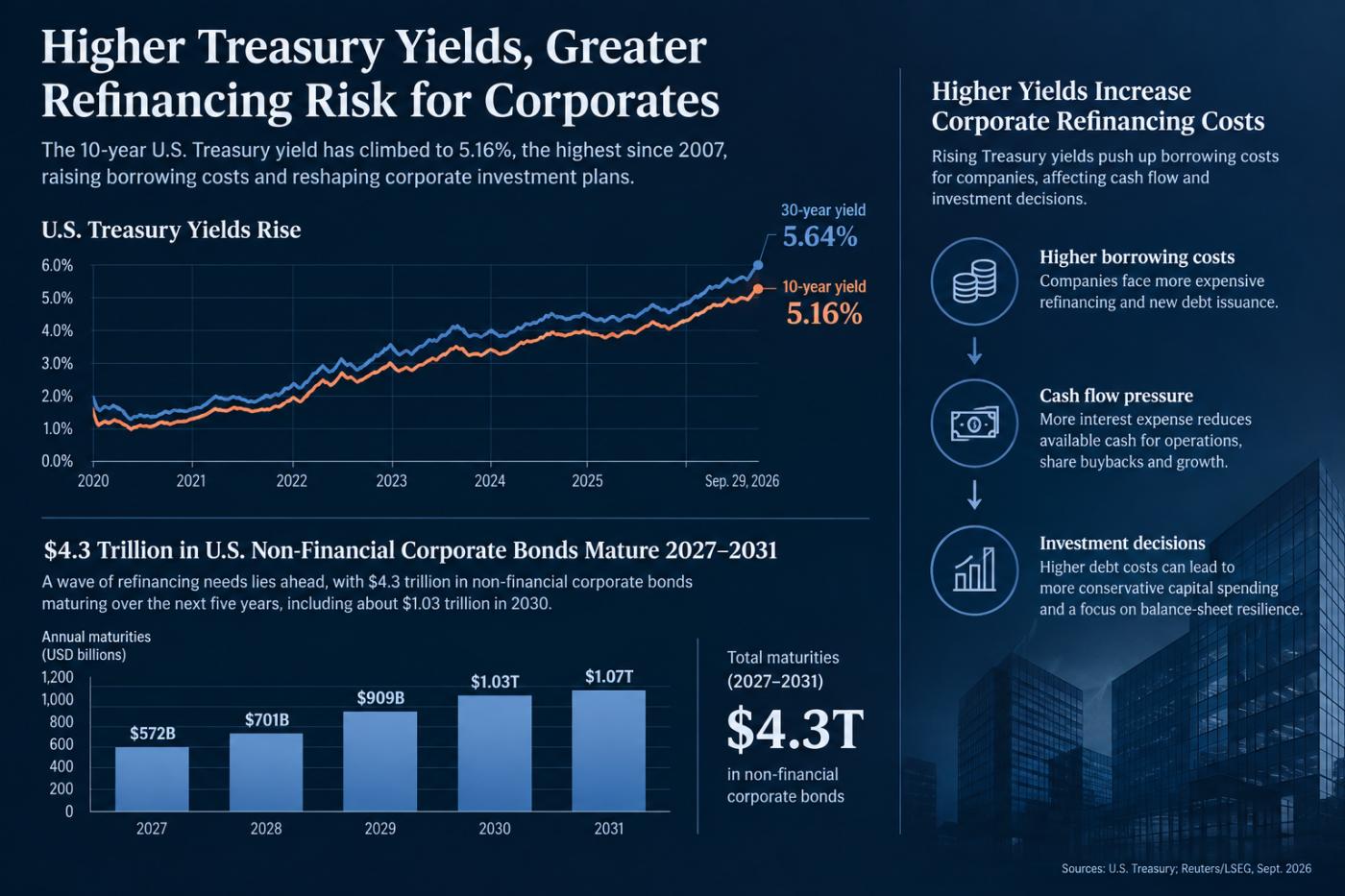
The U.S. Treasury market has entered a phase in which the most important question is no longer simply where bond yields are headed, but how quickly higher yields are being transmitted into corporate balance sheets. The 10-year Treasury yield reached 5.16% on September 29, 2026, according to the U.S. Treasury's official par-yield data, while the 30-year yield reached 5.64%. The 10-year rate is back around levels last seen before the global financial crisis, while the longer bond has moved to its highest territory in more than two decades.
The move is particularly significant because companies do not finance themselves at the Treasury rate alone. Treasury yields form the base rate for much of the corporate bond market. A company issuing a five-, seven- or 10-year bond normally pays the corresponding Treasury yield plus a credit spread reflecting its financial risk. When the Treasury component jumps rapidly, even a company whose credit spread remains unchanged can face a substantially higher refinancing cost. The Treasury's daily yield data therefore provide a useful starting point for understanding a corporate-finance problem that may become more visible over the next several years.
A rapid repricing after a relatively calm summer
The speed of the move matters almost as much as the absolute yield. Deloitte chief U.S. economist Ira Kalish reported earlier in September that the 10-year Treasury had reached 4.96%, describing the sharp rise in global bond yields as the “prime focus” of financial-market observers because of its effect on credit markets and government financing. By September 29, the official Treasury par yield was 5.16%, meaning the benchmark had added roughly 20 basis points in a matter of weeks after already rising substantially during the summer.
The change has occurred alongside a repricing of expectations for monetary policy and inflation. On September 16, the Federal Reserve raised the federal funds target range by 25 basis points to 3.75%-4.00%. The Federal Open Market Committee said that inflation remained elevated, while also describing economic activity as expanding at a solid pace, productivity growth as strong and capital investment as robust. This combination is important for businesses: the current bond sell-off is not being driven solely by expectations of economic weakness. Some of the pressure reflects investors demanding higher yields because nominal growth, inflation and financing requirements may remain higher than previously expected.
That distinction changes how the corporate sector should be viewed. A recession-driven rise in credit spreads would be a different problem from a Treasury-driven increase in the risk-free rate. In the first case, investors would be demanding more compensation for corporate default risk. In the second, even financially healthy companies can see their cost of capital rise because the foundation beneath their borrowing costs has shifted.
The refinancing wall makes the timing important
The corporate sector has an unusually important reason to care about the level of long-term yields: a large amount of debt issued during the era of exceptionally cheap financing is approaching maturity. Reuters, using LSEG data, estimates that approximately $4.3 trillion of U.S. non-financial corporate bonds will mature between 2027 and 2031. Annual maturities are projected to increase from about $572 billion in 2027 to roughly $1.03 trillion in 2030.
This creates a fundamental difference between the interest rate on existing debt and the interest rate on replacement debt. A company that issued a 10-year bond at 3% several years ago does not suddenly pay 5% merely because the Treasury market has moved. Its contractual coupon remains 3% until maturity. The economic pressure arrives when that bond must be refinanced.
That lag can make a high-rate environment appear relatively harmless at first. Aggregate corporate interest expense may rise only gradually because companies have locked in large portions of their debt for several years. But the refinancing calendar effectively creates a delayed transmission mechanism. Each maturity becomes a point at which the old interest rate can be replaced by the new market rate.
The Federal Reserve's research provides an important theoretical and empirical link between this maturity structure and investment. A 2024 Federal Reserve paper by Joachim Jungherr, Matthias Meier, Timo Reinelt and Immo Schott found that firms with a greater share of debt coming due respond more strongly to monetary-policy changes. The authors identify both “roll-over risk” and “debt overhang” as mechanisms through which debt maturity affects corporate investment. In other words, refinancing risk is not merely an accounting issue; it can influence whether a company spends money on new factories, equipment, technology or acquisitions.
Why a 5% Treasury yield can change a company's investment decision
Consider a simplified example. Suppose a company is considering a $1 billion manufacturing project expected to generate $75 million of additional annual operating cash flow for many years. When the company's cost of capital is relatively low, the project may comfortably clear its internal investment hurdle. If the risk-free rate rises by more than a percentage point, however, the required return on the project can rise even if the company's operating forecast remains unchanged.
At that point management does not necessarily cancel the project. Instead, the investment decision can change at the margin. A factory expansion may be delayed. A second production line may be installed later. Equipment may be leased rather than purchased. A company may prioritize projects with faster payback periods. An acquisition may be funded partly with equity instead of debt. Share repurchases may be reduced to preserve cash. Working-capital targets may become tighter.
These decisions can occur without a dramatic deterioration in corporate earnings. That is one of the less obvious consequences of a rapidly rising Treasury yield. Higher rates can affect the economy not only by making borrowing more expensive, but by changing the ranking of projects inside corporate capital-allocation systems.
The effect is likely to be uneven. A highly profitable company with substantial cash reserves and long-dated fixed-rate debt can absorb higher market yields without immediately changing its behavior. A highly leveraged company with large maturities approaching in 2027-2030 has much less flexibility. The same 100-basis-point increase in market yields can therefore be almost irrelevant to one balance sheet and strategically important to another.
The credit spread is the second half of the equation
The Treasury yield is only the first component of corporate borrowing costs. Investors also demand a credit spread. If the 10-year Treasury is 5.16% and a company pays a 1.50 percentage-point spread, its indicative borrowing cost is around 6.66%. If Treasury yields rise to 5.75% while the spread remains unchanged, the company's financing cost rises to approximately 7.25%.
The more serious scenario occurs when both components rise. A Treasury sell-off can initially occur while corporate credit spreads remain relatively contained. But if investors subsequently become concerned about weaker corporate cash flows, leverage or refinancing needs, credit spreads can widen as well. The resulting increase in the all-in borrowing rate can be considerably larger than the Treasury move alone.
Current conditions are important in this respect because the Federal Reserve's May 2026 Financial Stability Report described investment-grade corporate credit quality as robust and noted that corporate bond spreads remained low by historical standards. It also warned that some riskier firms, particularly those dependent on private credit, were facing debt-servicing challenges. The Fed specifically noted that higher rates combined with upcoming refinancing needs could amplify vulnerabilities for highly leveraged companies.
This means the present situation is not equivalent to a generalized corporate-credit crisis. The available evidence points to considerable resilience among higher-quality borrowers. The risk is instead concentrated in the transition from today's relatively comfortable debt service to tomorrow's refinancing requirements.
The hidden balance-sheet choice: refinance, repay or shrink
Companies approaching maturity have several choices, and each can affect business activity differently.
The first is straightforward refinancing. The company replaces maturing bonds with new debt and accepts the higher interest expense. This preserves cash for investment but increases future fixed obligations.
The second is debt repayment. A company can use accumulated cash to retire some or all of the maturing debt. That reduces future interest expense and leverage, but it also removes cash that could otherwise fund capital expenditure, acquisitions, research or shareholder distributions.
The third is balance-sheet restructuring. Management can sell assets, reduce inventories, cut operating costs, issue equity or renegotiate financing arrangements. These measures can strengthen resilience but may also reduce the company's ability to pursue growth opportunities.
The fourth is to change the investment portfolio itself. If borrowing becomes more expensive, projects with low expected returns become harder to justify. Capital allocation can consequently become more selective even while total corporate investment remains positive.
This is where Treasury-market volatility becomes more consequential than a headline yield number suggests. A sudden move can create uncertainty about what the refinancing rate will be when a company's debt matures. Corporate treasurers therefore face not only a higher expected cost of capital but also greater uncertainty around that cost.
AI investment creates an unusual counterforce
One reason the current cycle is particularly unusual is that some of the largest corporate investment programs are occurring at the same time that financing costs are rising. Artificial-intelligence infrastructure requires enormous spending on data centers, electricity supply, networking equipment and computing hardware. Several large technology companies have increasingly turned to debt markets to supplement internally generated cash for those investments.
This creates a competition for capital that did not exist to the same degree during the low-rate period following the financial crisis. Governments need to issue substantial quantities of debt, while companies pursuing data-center and AI infrastructure projects also require financing. Higher Treasury yields can therefore reflect both the supply of government debt and investors' assessment of the amount of capital required elsewhere in the economy.
There is an important paradox here. Strong capital investment can contribute to economic growth and productivity, which can support higher equilibrium interest rates. But higher rates can simultaneously make marginal investment projects less attractive. The economy can therefore experience a period in which investment remains strong in high-return sectors such as AI infrastructure while weaker projects are postponed.
The Federal Reserve's September statement provides evidence that this distinction matters. The central bank said capital investment was robust even as it raised rates and acknowledged that inflation remained elevated. This suggests that higher financing costs have not yet overwhelmed the investment cycle. The question is how much of that resilience survives as more companies encounter refinancing dates.
What corporate resilience could look like in 2027-2030
The refinancing wall should not automatically be interpreted as a forecast of widespread corporate distress. Companies have had years to extend maturities, accumulate liquidity and adjust capital structures. The Federal Reserve has also reported that overall business and household debt relative to GDP has declined to levels not seen since the early 2000s.
But aggregate resilience can conceal significant dispersion. Investment-grade companies with strong cash generation can potentially refinance at higher rates while continuing to invest. Companies with weaker credit ratings may face a more difficult trade-off between paying higher interest and preserving investment spending. The Reuters analysis found that high-yield maturities are also rising substantially as the refinancing wave progresses, increasing the exposure of weaker borrowers to market conditions.
The critical variable may therefore be interest coverage rather than the absolute debt balance. A company with $10 billion of debt and $3 billion of annual operating cash flow is in a different position from one with the same debt but only $1 billion of cash flow. Similarly, two companies with identical debt can have very different risk depending on whether their maturities occur next year or five years from now.
For investors and analysts, the maturity schedule consequently becomes almost as important as the income statement. The key questions are how much debt matures each year, what coupon it currently carries, whether it is fixed or floating, how much cash the company has, how much free cash flow it generates and how much new borrowing is required to maintain its planned investment program.
The broader economic transmission mechanism
The most important insight from the Treasury sell-off may therefore be that monetary tightening does not need to produce an immediate recession to influence corporate behavior. The transmission can occur through the cost and availability of capital.
First, Treasury yields rise. Second, corporate borrowing costs increase because the risk-free component of those yields is higher. Third, companies approaching maturity reassess refinancing plans. Fourth, management teams compare the increased cost of debt with expected returns from new projects. Finally, projects with lower returns may be postponed, resized or abandoned while higher-return projects continue.
This mechanism can operate slowly enough to be missed by conventional economic indicators. A company can report strong revenue, rising profits and healthy employment while simultaneously reducing planned capital expenditure because its hurdle rate has changed. Conversely, a company can continue investing aggressively because its projects generate returns sufficiently high to justify the new financing environment.
That makes the Treasury yield a kind of economy-wide price signal. At 5.16%, the signal is not simply that government borrowing has become more expensive. It is that the minimum return investors can demand from a wide range of assets has moved materially higher. Companies now have to compete against a much more attractive risk-free return when deciding where to place incremental capital.
The September 2026 bond sell-off therefore deserves attention beyond the daily movements of Treasury prices. The immediate market question is whether yields stabilize. The corporate question is more consequential: how much of the $4.3 trillion refinancing wave arriving between 2027 and 2031 will be absorbed through higher interest expense, how much through lower investment, and how much through stronger balance sheets built before maturity arrives?
The answer will vary sharply by company. But the distinction between a higher borrowing rate and a higher hurdle rate for investment is becoming increasingly important. If Treasury yields remain elevated, the effects may emerge gradually not as a single credit shock, but as thousands of corporate decisions about which projects still make economic sense when money is no longer cheap.