business
Beyond UPI: India's Next Big Financial Breakthrough
India's digital financial infrastructure is evolving far beyond UPI. Discover how Account Aggregators, GST e-invoicing, OCEN and consent-based financial data are transforming MSME lending by enabling cash-flow-based credit assessment, reducing reliance on physical collateral and reshaping competition between banks and fintech lenders.





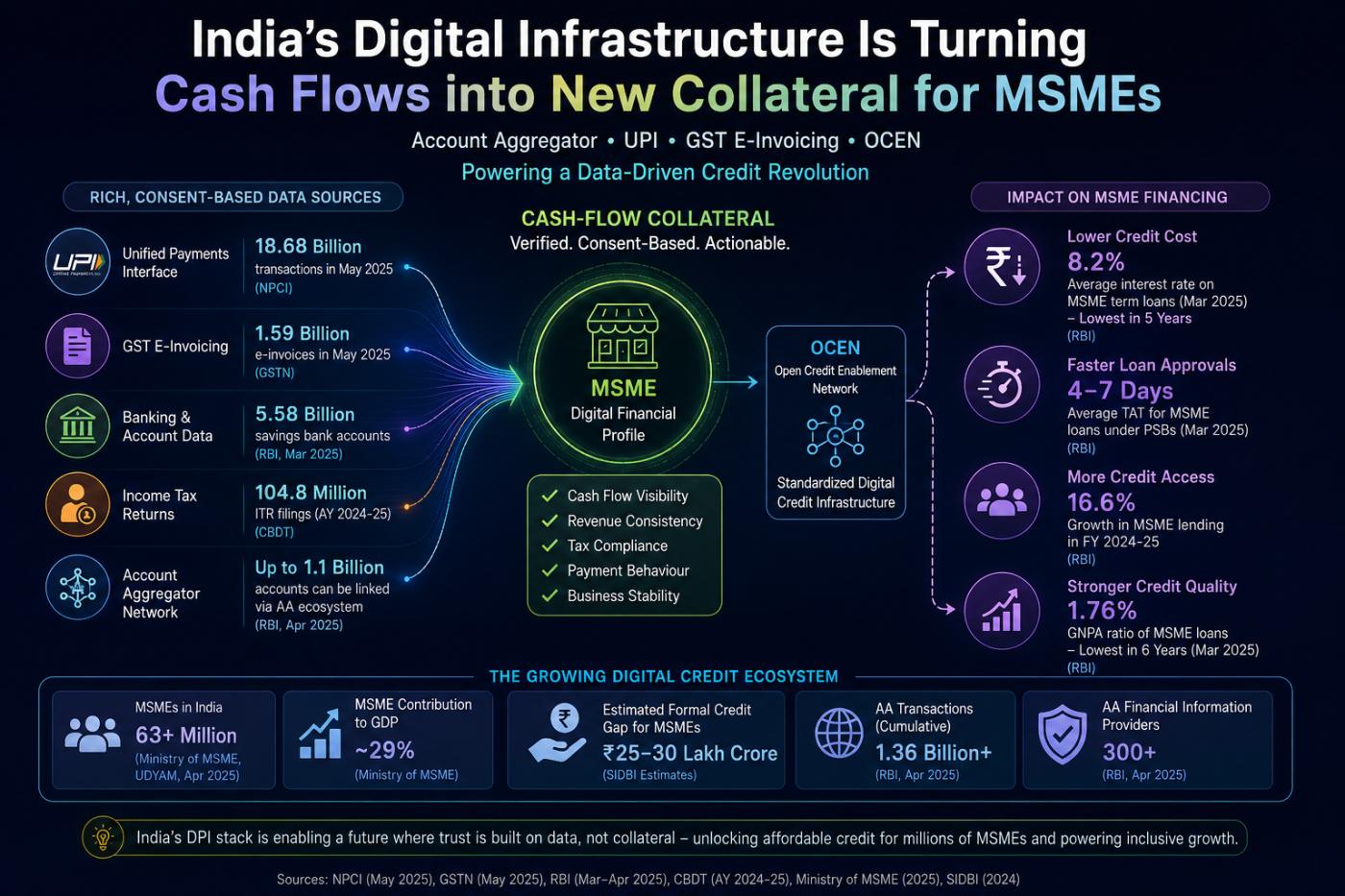
India's Digital Public Infrastructure (DPI) has become synonymous with the success of the Unified Payments Interface (UPI). Every month, billions of digital transactions demonstrate the country's remarkable progress in payment innovation. Yet beneath those impressive numbers, another transformation is quietly unfolding one that could ultimately have a much larger impact on India's economy.
The convergence of the Account Aggregator (AA) framework, GST e-invoicing, Open Credit Enablement Network (OCEN), digital banking and consent-based financial data sharing is gradually changing how lenders assess businesses. Instead of relying primarily on land, buildings or machinery as collateral, financial institutions are beginning to evaluate the quality and consistency of a business's cash flows.
This emerging concept best described as cash-flow collateral could reshape lending to India's millions of Micro, Small and Medium Enterprises (MSMEs). While UPI dominates public discussion, this structural evolution in credit markets may become one of the most significant financial reforms of the decade.
India's MSME Credit Gap Has Always Been an Information Problem
MSMEs contribute approximately one-third of India's Gross Value Added, generate nearly half of the country's merchandise exports and employ well over 100 million people. Despite their importance, access to affordable formal credit has remained one of the sector's biggest constraints.
Research published by the Reserve Bank of India (RBI), SIDBI, the Ministry of MSME and international institutions has consistently highlighted a substantial financing gap for Indian MSMEs. Many viable businesses remain underserved despite maintaining profitable operations.
The underlying issue has often been information rather than business quality.
Traditional lenders have depended heavily on collateral because smaller enterprises frequently lacked audited financial statements, long credit histories or valuable assets that could be pledged against loans. In the absence of reliable financial information, physical collateral became the simplest method of managing lending risk.
While prudent from a risk-management perspective, this approach excluded countless businesses with stable revenues but limited physical assets.
India's Digital Public Infrastructure Is Solving Information Asymmetry
India's Digital Public Infrastructure has evolved into a sophisticated ecosystem where multiple platforms work together to create trusted financial information.
Each component contributes a different layer of verified data:
- UPI records authenticated payment transactions.
- GST returns and e-invoicing capture business sales and commercial activity.
- Bank accounts reflect cash-flow patterns.
- Account Aggregators enable secure, consent-based financial data sharing.
- OCEN standardizes digital credit origination across lenders.
Individually, each platform improves transparency. Together, they create a comprehensive digital financial profile that allows lenders to assess businesses using real operating data rather than incomplete paperwork.
Cash-Flow Collateral May Become the Next Evolution of Business Lending
Traditional collateral protects lenders after a borrower defaults. Cash-flow collateral seeks to reduce default risk before lending decisions are made.
Consider a manufacturing enterprise that owns little real estate but consistently demonstrates:
- Stable GST invoices
- Regular UPI collections
- Predictable supplier payments
- Timely tax compliance
- Healthy banking activity
- Recurring customer revenues
Viewed independently, these data points may appear ordinary. Combined, however, they paint a highly reliable picture of business stability.
Through the RBI-regulated Account Aggregator framework, businesses can securely share verified financial information with lenders without exposing passwords or manually collecting paper records. This significantly reduces uncertainty during underwriting and allows financial institutions to evaluate repayment capacity based on actual commercial behaviour.
In practical terms, consistent cash flows begin to function much like traditional collateral by reducing lending risk.
The Account Aggregator Framework Gives Businesses Control of Their Financial Data
One of the most significant innovations within India's financial architecture is the shift in data ownership.
Historically, financial institutions controlled customer financial information. Under the Account Aggregator ecosystem regulated by the RBI, customers control who can access their financial data and for what purpose.
Data sharing occurs only after explicit customer consent and follows standardized technical protocols designed to protect privacy and security.
For MSMEs, this dramatically reduces documentation burdens. Instead of collecting statements from multiple institutions over several days or weeks, businesses can securely authorize verified data sharing within minutes.
This benefits both lenders and borrowers by improving efficiency while preserving customer control over sensitive financial information.
GST E-Invoicing Is Quietly Becoming a Powerful Credit Assessment Tool
GST is often viewed primarily as a tax reform. Its influence on lending may prove equally significant.
GST returns and e-invoicing generate standardized, high-quality records of commercial activity throughout the year. Unlike manually prepared financial statements, these records reflect actual business transactions.
Financial institutions can use GST-related information to better understand:
- Revenue consistency
- Business growth trends
- Seasonal demand cycles
- Customer concentration
- Invoice frequency
- Tax compliance behaviour
When combined with banking information shared through Account Aggregators, lenders obtain a far richer understanding of enterprise performance than traditional documentation alone can provide.
This improves underwriting quality while reducing dependence on physical collateral.
OCEN Could Democratize Digital Lending Across India
The Open Credit Enablement Network (OCEN) receives far less public attention than UPI despite its potential to reshape India's lending ecosystem.
Rather than operating as a lender, OCEN provides standardized digital protocols that enable banks, NBFCs, fintech companies and online platforms to offer credit more efficiently.
Because institutions no longer need customized technology integrations with every digital platform, the cost of offering embedded credit declines substantially.
This increases competition.
Businesses gain access to a wider range of financing providers, while lenders compete through pricing, underwriting expertise, customer experience and operational efficiency instead of relying primarily on branch networks.
Better Financial Data Can Lead to Better Loan Pricing
Traditional lending frequently places businesses into broad risk categories because available information is limited.
Consent-based digital financial data allows lenders to assess enterprises with much greater precision.
Two businesses operating within the same industry may appear identical under conventional underwriting models. However, verified transaction histories may reveal significant differences in customer diversification, revenue stability and payment discipline.
Businesses demonstrating stronger financial performance may therefore qualify for more competitive borrowing costs.
Over time, improved data quality enables lenders to allocate capital more efficiently while strengthening overall portfolio quality.
Banks and Fintech Companies Are Becoming Partners Rather Than Competitors
Public discussion often frames banks and fintech firms as rivals. India's Digital Public Infrastructure increasingly encourages collaboration instead.
Banks contribute regulatory expertise, customer trust and large balance sheets. Fintech companies specialize in automation, digital onboarding, customer experience and advanced analytics.
Shared infrastructure such as Account Aggregators and OCEN allows both groups to leverage their respective strengths.
This collaborative model has the potential to improve financial inclusion while maintaining prudent lending standards.
Why This Structural Shift Receives Less Attention Than UPI
UPI transaction volumes are easy to measure and produce headline-grabbing monthly statistics.
Credit infrastructure evolves differently.
Its benefits emerge gradually through:
- Lower borrowing costs
- Faster loan approvals
- Improved financial inclusion
- Reduced paperwork
- More accurate credit pricing
- Greater competition among lenders
- Better allocation of capital across the economy
These improvements accumulate over years rather than months, making them less visible despite their potentially larger economic impact.
Cash-Flow Collateral Could Define the Next Phase of India's Financial Inclusion
India has already demonstrated how Digital Public Infrastructure can transform payments at national scale. The next phase may involve transforming credit itself.
The integration of UPI, Account Aggregators, GST digitization, OCEN and consent-based financial data sharing is gradually expanding the definition of creditworthiness.
Instead of relying primarily on physical assets, lenders are increasingly able to evaluate verified financial behaviour generated through everyday business operations.
This represents an important shift for millions of entrepreneurs who possess strong businesses but limited collateral.
Physical assets will remain important for many lending decisions. However, trusted digital financial records are becoming valuable economic assets in their own right.
If this transition continues, India may eventually become the world's leading example of how Digital Public Infrastructure can transform not only payments but also the allocation of productive capital. UPI may have changed how India pays, but the country's evolving financial data ecosystem could ultimately change how India grows.