business
UPI Meets the Post Office: A Remittance Story
How India's century-old postal network and its record-breaking UPI payments system are being fused through a landmark NPCI-UPU project to serve diaspora remittances and last-mile financial inclusion.





On a September afternoon in Dubai last year, in a conference hall filled with postal administrators from 192 countries, Union Minister Jyotiraditya Scindia stood at the podium of the 28th Universal Postal Congress and made an announcement that had almost nothing to do with stamps or parcels. He was there to launch a payments project. Specifically, he was there to tell the world that India's postman and India's UPI app were about to start working together.
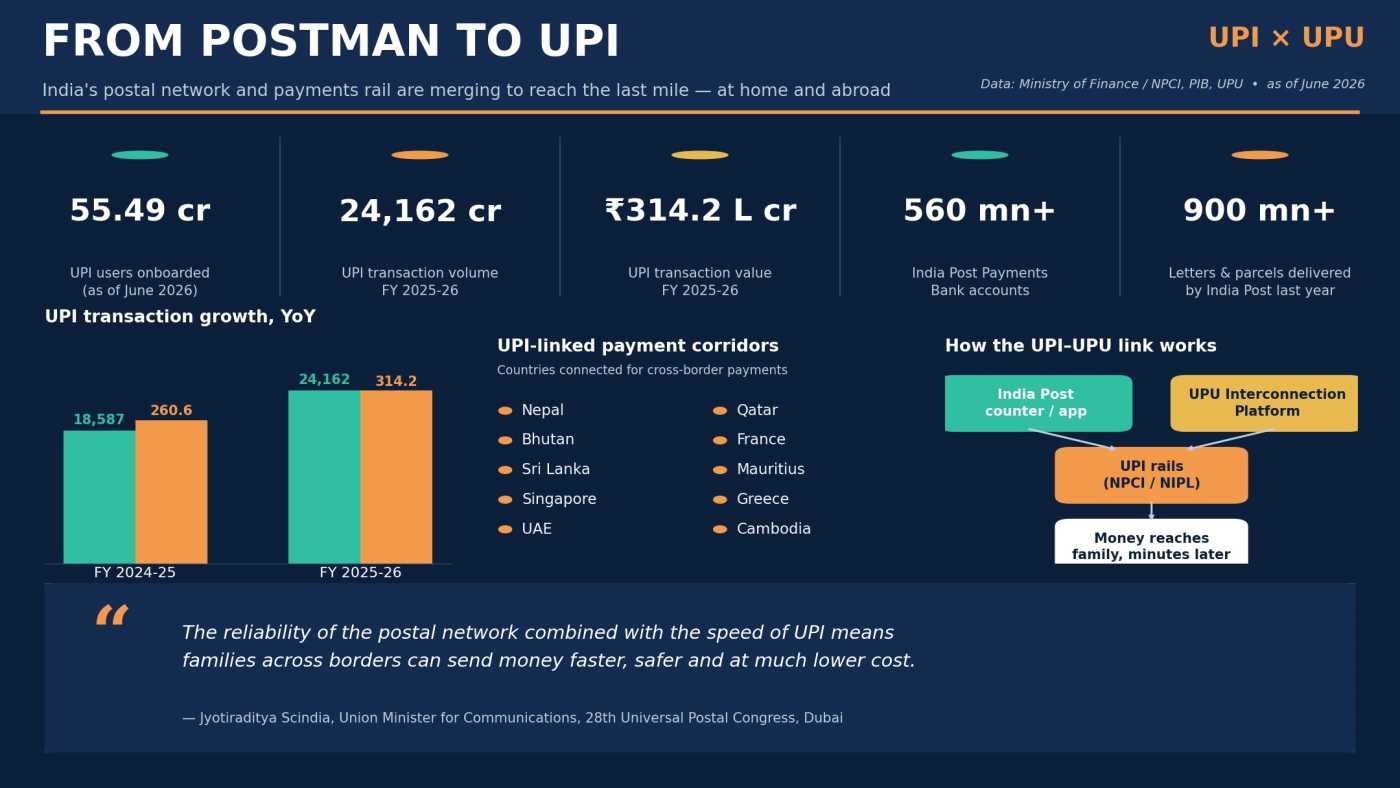
"The reliability of the postal network combined with the speed of UPI means families across borders can send money faster, safer and at much lower cost," Scindia said, calling the UPI–UPU Integration project "more than a technology launch, but a social compact." It is an unusual sentence to hear from a telecom and postal minister, and an even more unusual pairing to see on a stage: the 150-year-old machinery of the Universal Postal Union, the treaty body that keeps the world's mail systems talking to each other, wired directly into the Unified Payments Interface, the seven-year-old real-time payments rail that has become the backbone of daily transactions in India.
Two infrastructures, one migrant worker
The joint initiative, developed by the Department of Posts, NPCI International Payments Limited (NIPL) and the UPU, connects UPI with the UPU's Interconnection Platform, a system originally built to let postal money orders move between member countries. In practice, this means a construction worker in the Gulf or a caregiver in Southeast Asia may eventually be able to send money home through a post office counter or app, with the transaction settling over UPI rails rather than through a chain of correspondent banks and currency converters.
UPU Director General Masahiko Metoki, who co-launched the project with Scindia, praised India's role as co-chair of the union's Postal Operations Council, and its long track record on international remittances. The choice of venue mattered: postal networks reach places that neither fintech apps nor bank branches always do, particularly in smaller towns and among first-generation migrants who are more comfortable walking into a post office than downloading a new app. Scindia made this explicit in his remarks, pointing to India's own experience at home. "With Aadhaar, Jan Dhan and India Post Payments Bank, we have opened over 560 million accounts, most in women's names. India Post delivered over 900 million letters and parcels last year," he said, describing this as "the scale and spirit of inclusion we bring to the global stage."
The scale that makes the experiment plausible
None of this would carry much weight if UPI itself weren't already operating at a size few payment systems in the world can match. According to a Ministry of Finance press release citing NPCI data, placed before the Lok Sabha this July by Minister of State for Finance Pankaj Chaudhary, UPI had onboarded 55.49 crore users as of June 2026, with transactions in FY2025-26 reaching 24,161.69 crore in volume worth ₹314.23 lakh crore, up from 18,586.60 crore transactions worth ₹260.56 lakh crore the year before. That is a system processing, on average, well over six billion transactions a month, almost entirely domestically. The remittance corridor is where the numbers get more interesting for the postal story, because NIPL, the international arm of NPCI, has spent the last two years quietly building exactly the kind of cross-border plumbing the UPU project now hopes to plug into.
By the ministry's own account, UPI has already been linked with payment systems in a scattered, almost improvised-looking list of countries Nepal, Bhutan, Sri Lanka, Singapore, France, Mauritius, the UAE, Qatar and, more recently, Greece and Cambodia for both person-to-person and person-to-merchant transactions. Some of these links are aimed at travellers; UPI is now accepted by merchants near the Eiffel Tower in Paris and across the UAE's retail and hospitality sector. Others are aimed squarely at remittances. Ritesh Shukla, MD and CEO of NPCI International, has been a visible presence at UAE trade events pushing merchant acceptance, working alongside Indian consular officials such as Satish Kumar Sivan, who has noted that roughly 5.5 million Indian tourists visited the UAE in a single recent year a travel and remittance corridor NIPL is trying to capture end to end, from the airport taxi to the money sent home each month.
Why the post office is the missing piece
The obvious question is why India needs its postal network at all when UPI already works through phones. The answer lies in who UPI has not yet reached. Domestically, India Post Payments Bank has opened accounts overwhelmingly for people who were previously outside formal banking largely rural, often women, frequently without smartphones sophisticated enough for app-based banking but entirely comfortable with a postal counter and a passbook. Internationally, the picture rhymes: a large share of India's inbound remittances still originates from blue-collar and semi-skilled workers in the Gulf, whose home districts in Kerala, Uttar Pradesh, Bihar and Punjab are served far more reliably by post offices than by bank branches or fintech app support centres. A worker who wants to send ₹15,000 home every month cares less about interface design than about a trusted, physical counter at both ends of the transaction precisely the gap a postal-payments hybrid is built to close.
This is also, commercially, a two-sided bet. For postal administrations elsewhere in the UPU's 192-member network, plugging into UPI-linked rails offers a modern, low-cost alternative to legacy money-order systems and a new revenue line at a moment when letter volumes are falling worldwide. For India, every remittance dollar that moves through a UPI-linked corridor rather than a private money-transfer operator is a dollar that stays cheaper for the sender and more traceable for the receiving system an outcome regulators have quietly wanted for years without quite being able to engineer through banking channels alone.
An old institution finding new relevance
What makes this story worth separating from the routine drumbeat of UPI transaction-volume headlines is the direction of travel. Most of India's digital-payments narrative has been about newness displacing the old: apps replacing cash, QR codes replacing cards, instant transfers replacing cheques. The UPI–UPU integration inverts that story. Instead of retiring the postal network, India is trying to graft its newest financial infrastructure onto its oldest one, on the theory that reach and trust built over a century are not liabilities to be engineered around but assets to be reused.
Scindia's closing line in Dubai captured that theory better than any transaction statistic could: "India comes to you not with proposals, but with partnership. We believe in resilience, enabling interoperable solutions that avoid costly fragmentation, and in trust, linking payments, identity, addressing and logistics so that global commerce becomes seamless." It is a fairly large claim to rest on a memorandum signed at a postal congress. But with UPI already carrying more transactions in a single month than many national systems handle in a year, and with NIPL steadily adding remittance corridors across the Gulf, Europe and Southeast Asia, the postman and the payments app are, for the first time, pointed in the same direction toward the same migrant household, on the same afternoon, trying to send money home a little faster and a little cheaper than before.