business
Why Electricians Now Out-Earn Software Engineers
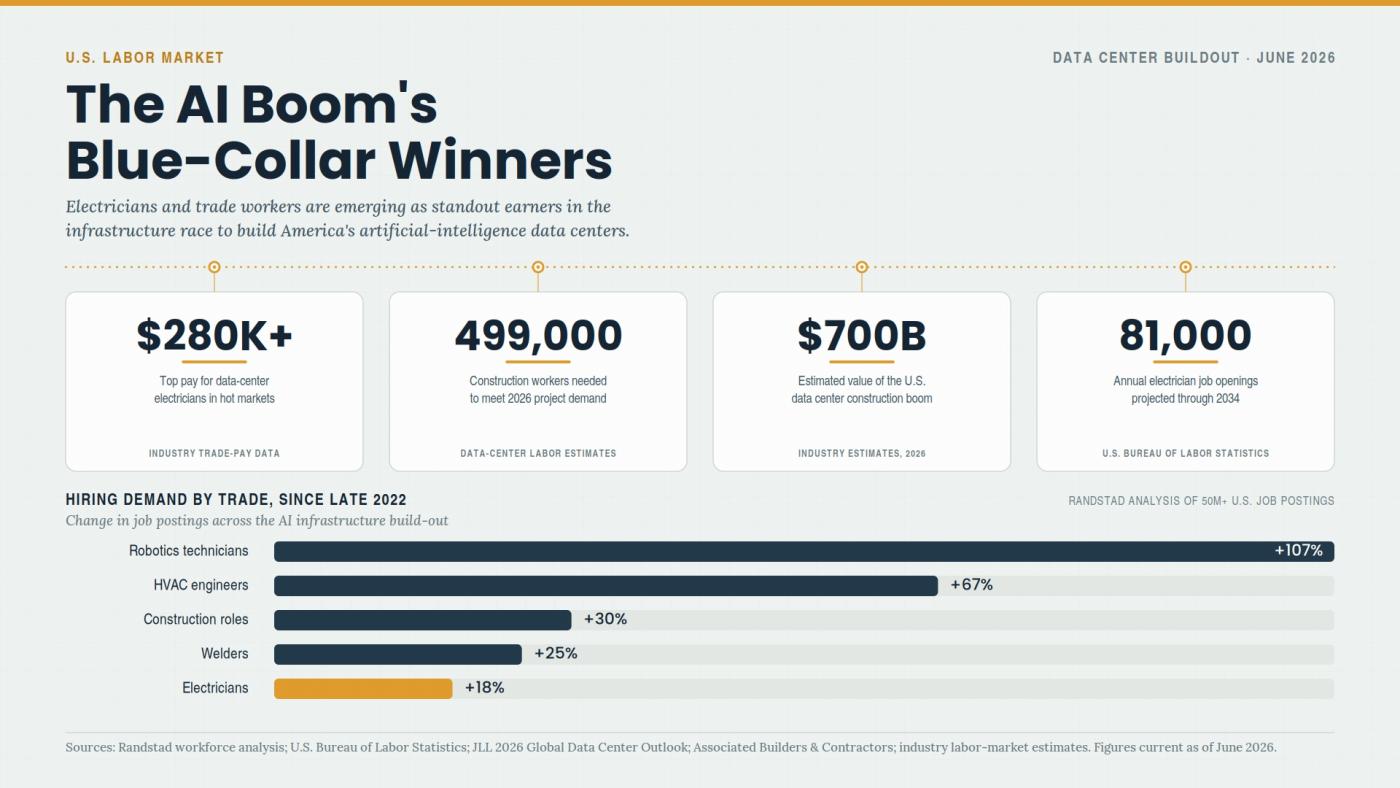
As AI threatens white-collar jobs, the nearly $700 billion data center construction boom is making electricians, HVAC technicians, and linemen some of the best-paid workers in America, with data-center electricians clearing over $280,000 amid a severe nationwide skilled-trades shortage.





The artificial intelligence boom was supposed to be a story about software swallowing the world — algorithms replacing analysts, chatbots replacing customer service reps, and code that writes more code. Instead, as of mid-2026, one of the clearest winners of the AI buildout isn't anyone who can write a line of Python. It's the electrician pulling conduit through a half-built server hall in rural Virginia, the HVAC technician calibrating liquid-cooling loops in Texas, and the lineman stringing new transmission wire across the Midwest. The infrastructure required to run AI has turned into one of the most lucrative blue-collar opportunities in a generation, even as the white-collar jobs AI is meant to automate keep shrinking.
A nearly $700 billion construction project hiding in plain sight
The scale of the physical buildout is easy to underestimate because so much of the AI narrative is fixated on chips and models. But somebody has to pour the concrete, run the high-voltage gear, and keep thousands of servers from overheating. Data center construction in the United States is now estimated at nearly $700 billion, and according to JLL's 2026 Global Data Center Outlook, the sector could add roughly 97 gigawatts of capacity between 2025 and 2030 — effectively doubling existing global capacity. Construction costs per megawatt have climbed from $7.7 million in 2020 to $10.7 million in 2025, a trajectory JLL expects to keep rising into 2026. None of that money goes toward training a model. It goes toward switchgear, substations, fiber runs, cooling systems, and the specialized labor needed to install and commission all of it.
That labor is in desperately short supply. Industry estimates cited by data center labor analysts point to a shortfall of up to 499,000 construction workers nationally, with roughly 41% of the existing skilled workforce expected to retire by 2031. Tony Qorri, vice president of construction at DataBank, has warned that the back half of 2026 into 2027 will bring a wave of new project activations that the trades simply aren't staffed to handle. The bottleneck isn't chips or capital anymore — it's people who know how to safely energize a 500-megawatt campus.
Where the AI money is actually landing
For workers willing to pick up a multimeter instead of a laptop, the payoff has been substantial. Pay across core trades now spans roughly $51,000 to over $106,000 from apprentice to specialist level, with data-center electricians in high-demand markets pushing north of $280,000 once overtime, certifications, and project premiums are factored in. In Northern Virginia — the densest data center corridor in the country — electricians are routinely clearing more than $120,000 a year in base pay alone. Nationally, the Bureau of Labor Statistics projects roughly 81,000 electrician job openings annually through 2034, a pace it classifies as much faster than average.
A staffing executive who works directly with hyperscale developers put the shift in stark terms. Carrie Charles, CEO of the recruiting firm Broadstaff, which places technical talent with companies including Verizon and Oracle, has watched demand for skilled electricians and technicians surge as the AI infrastructure buildout accelerates. She has been encouraging laid-off tech workers to consider the field, describing it in a recent interview as something close to a hybrid career path. "It's almost like a white-collar trade job," Charles said of the technician roles her firm fills, adding, "It's a technical role, but you're not sitting all day long." Her framing captures something real: these are not the grimy, low-status trade jobs of stereotype. They involve commissioning checklists, redundant power systems, and the same kind of methodical troubleshooting that drew many people into engineering in the first place — just applied to physical infrastructure instead of code.
The numbers behind the shift
An analysis of more than 50 million job postings by the staffing firm Randstad shows just how lopsided the demand curve has become. Since late 2022, demand for robotics technicians has jumped 107%, HVAC engineers have risen 67%, and general construction roles tied to the AI buildout are up 30%. Welders and electricians have grown a more modest but still notable 25% and 18%, respectively, over the same period, according to Randstad's findings, reported by Fortune. The same period has seen white-collar tech employers, including Amazon, Meta, and Oracle, continue trimming headcount in the name of efficiency — the very companies driving the demand for skilled trades are simultaneously the ones laying off office staff. As of April 2026, roughly 96,000 tech employees had already been let go for the year, with projections topping 300,000 by year's end, though notably only a fraction of those cuts are directly attributable to AI itself rather than post-pandemic overhiring corrections.
The supply side of this equation is the more sobering half of the story, and it's also what makes the wage growth durable rather than a temporary spike. The National Association of Manufacturers has projected a shortfall of 1.9 million manufacturing workers by 2033, and the Associated Builders and Contractors trade group estimates the industry will need nearly half a million new workers in 2027 alone, up from roughly 349,000 in 2026. Half of the licensed plumber workforce in the U.S. is already over the age of 50, according to Bureau of Labor Statistics data, and retirements are outpacing the number of new apprentices entering the field. In manufacturing more broadly, the churn is even starker: for every 100 young workers who enter the sector, roughly 102 leave it, a net negative replacement rate that all but guarantees wage pressure will keep building rather than easing.
Competing with chipmakers and the power grid for the same workers
Data center developers aren't just competing with each other for talent — they're competing with two other booming sectors chasing the same certified electricians and mechanical specialists. Semiconductor manufacturers building new fabrication plants and utilities racing to modernize an aging power grid for electric vehicles and renewable energy are drawing from the identical labor pool. Construction unemployment hit a record low of 3.2% in August 2025, which means there is effectively no reserve workforce sitting on the sidelines waiting to be hired. When three capital-intensive industries are simultaneously bidding for the same scarce electricians, the result is exactly what's showing up in paychecks: project backlogs stretching eight to twelve months in some markets, and contractors offering signing bonuses and accelerated apprenticeships just to keep crews staffed.
A geographic and generational reshuffling
What makes this trend particularly interesting from a financial perspective is where the money is landing. Data center construction isn't concentrated solely in coastal tech hubs; it's spreading wages into places like rural Virginia, parts of Texas, Ohio, and the Dakotas — regions that haven't typically captured much of the value created by the technology industry. For a welder or HVAC technician in a smaller metro, a single hyperscale campus project can mean sustained six-figure income without ever relocating to San Francisco or requiring a four-year degree.
It also helps explain a parallel shift already visible in education data: community college enrollment grew roughly 3% in fall 2025, with certificate programs jumping 6.6%, as more students — including career-changers in their 30s and 40s — gravitate toward shorter, job-aligned credentials instead of traditional bachelor's degrees. The labor market is sending a price signal, and increasingly, students and displaced professionals are responding to it.
An imperfect but real counterweight to AI anxiety
None of this erases the genuine disruption AI is causing in white-collar fields, and the trades boom shouldn't be read as a tidy solution to every job displaced by automation; switching from a desk career to high-voltage electrical work involves real retraining, physical demands, and licensing requirements that not every laid-off knowledge worker will be suited for or interested in. But as a counter-narrative to the more dire predictions about AI hollowing out the American workforce, the data center buildout offers something concrete: a multibillion-dollar, multi-year capital cycle whose biggest individual winners, in dollar terms, are often the people running conduit and balancing cooling loads rather than the people training the models. For an economy that has spent years worrying about robots taking blue-collar jobs, it's a notable reversal to watch the robots' own infrastructure create some of the best-paying blue-collar jobs in the country.