business
India's Solar Boom Is Also a Banking Revolution
An in-depth look at how India's decentralized solar boom, via PM-KUSUM, PM Surya Ghar, RBI's priority sector lending rules, and NABARD refinance schemes, is reshaping rural credit demand, loan repayment stability, and agricultural investment cycles, backed by IEA, IRENA, and NITI Aayog data.





India's clean energy expansion is usually narrated as a story about gigawatts, emission targets, and COP pledges. But a quieter, less-discussed shift is unfolding underneath that headline story: the way decentralized solar infrastructure is reshaping how rural India borrows, saves, repays, and invests. Institutions like NABARD, the Reserve Bank of India (RBI), the Ministry of New and Renewable Energy (MNRE), the International Energy Agency (IEA), IRENA and NITI Aayog have each, in their own domains, been documenting a slow convergence between energy policy and rural credit architecture. Read together, their data suggests that solar power is becoming less an environmental add-on and more a structural input into how rural financial systems function.
The Scale of the Shift
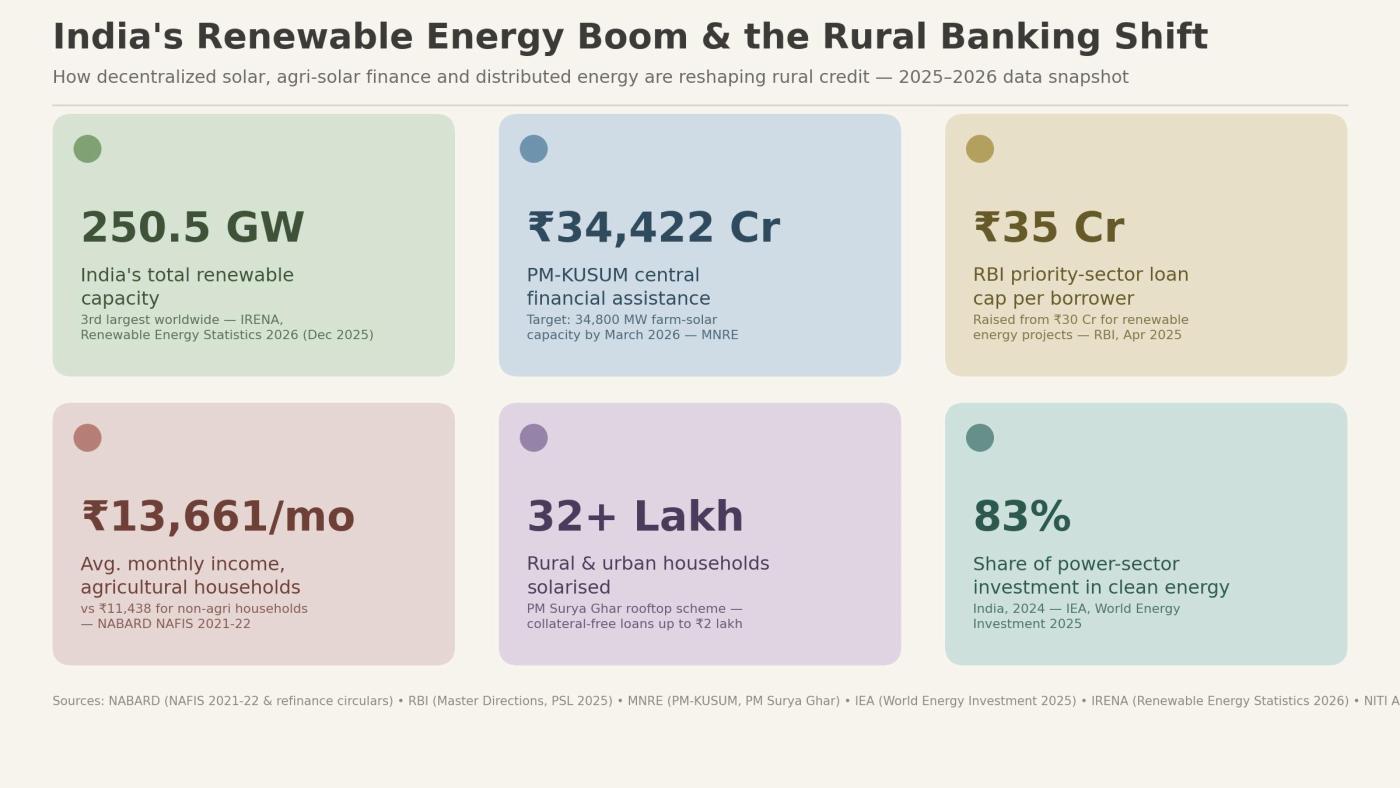
India's renewable build-out has been unusually fast by global standards. India ranked third globally in renewable energy installed capacity, reaching 250.52 GW as of December 2025, according to IRENA's Renewable Energy Statistics 2026, trailing only China and the United States. On the investment side, the International Energy Agency notes that growth in India's power generation has come from all sources, but there has been a surge in investment in renewables, led by solar PV, which constitutes more than half of total non-fossil investment over the past several years. Crucially for rural financial planners, 83% of power sector investment in India went to clean energy in 2024, and India was the world's largest recipient of development finance funding that year, receiving around USD 2.4 billion in project-type interventions for clean energy generation. This is not simply an urban, grid-scale phenomenon. A meaningful share of that capacity is landing directly on farms, feeders, and rooftops through schemes explicitly designed to sit at the intersection of agriculture and energy, and by extension, at the intersection of agriculture and credit.
PM-KUSUM: Where Solar Policy Becomes a Credit Instrument
The PM-KUSUM scheme, run by MNRE, is arguably the clearest example of energy policy being engineered as a financial inclusion tool rather than a pure infrastructure programme. The scheme aims to add 34,800 MW of solar capacity by March 2026, backed by total Central Financial Assistance of Rs 34,422 crore, including service charges to implementing agencies. Its three components, decentralized ground-mounted solar plants, standalone solar irrigation pumps, and solarisation of existing grid-connected pumps, were structured from the outset to work through formal lending channels rather than pure subsidy disbursal. Central financial assistance covers 30% of installation cost for most states, up to Rs 1.05 crore per MW, with the balance typically split between state contribution and farmer equity, equity that is frequently sourced through bank loans rather than out-of-pocket payment. This is where NABARD enters directly: loans for feeder separation, where agriculture feeders are not yet separated, can be sourced from NABARD or from PFC and REC, tying grid-level infrastructure financing to the same institutional machinery that handles crop loans and Kisan Credit Cards. The economic logic here is unusual for agricultural finance. Traditional crop loans are repaid from harvest proceeds, a single, seasonal, weather-dependent income event. Solar-linked lending, by contrast, is increasingly repaid from a second, more stable revenue stream: electricity savings or feed-in-tariff payments from DISCOMs. As former Union Power Minister R K Singh put it while explaining the feeder solarisation model, each state stood to save anything between Rs 6,000 crore to Rs 12,000 crore in agricultural power subsidy through this route, savings that, at the farmer level, translate into a predictable cash-flow buffer against which a bank can lend with more confidence than it would against monsoon-dependent yield alone.
Priority Sector Lending: RBI Widens the Credit Channel
The RBI's regulatory posture has moved in step with this shift. Renewable energy has been classified under Priority Sector Lending (PSL) since 2015, but the scope has been repeatedly widened. Under the Master Directions, Priority Sector Lending, Directions 2025, effective from April 1, 2025, the limit of bank loans has been increased to Rs 350 million for renewable energy-based generators, while public utilities based on renewable power sources, such as street lighting systems and remote village electrification, are also eligible for priority sector classification. The limit for individual households remains unchanged at Rs 1 million per borrower. This is a meaningful signal for rural lending institutions: it means Regional Rural Banks, cooperative banks, and small finance banks can count solar-linked agricultural lending toward their statutory priority sector obligations, rather than treating it as a niche, discretionary product. The RBI's 2025 revision also added weightage, 125% credit value, for loans disbursed in India's lower-income districts, nudging renewable-linked agri-finance toward exactly the geographies where rural banking penetration has historically lagged. NABARD has mirrored this at the refinance level. Its Special Refinance Scheme for residential rooftop solar, extended for Small Finance Banks, is available up to 30 September 2026, and can converge with the PM Suryaghar Muft Bijli Yojana or any other state solar rooftop scheme, with concessional refinance also available without such convergence. In effect, NABARD is underwriting the liquidity that local banks need to originate solar loans in the first place, a quieter but foundational piece of the rural credit puzzle.
What NAFIS Reveals About Repayment Behaviour
The strongest evidence that this credit shift is already showing up in rural balance sheets comes from NABARD's own All India Rural Financial Inclusion Survey (NAFIS). The 2021-22 round, covering roughly one lakh households, found that agricultural households consistently out-save and borrow more responsibly compared with non-agricultural rural households. Agricultural households reported average monthly earnings of Rs 13,661 against Rs 11,438 for non-agricultural households, and 71% of agricultural households reported positive savings compared with 58% of non-agricultural households. Among households holding a Kisan Credit Card, 83% of the sanctioned limit was actively utilised, an unusually high utilisation ratio that points to disciplined, need-based borrowing rather than dormant credit lines. This matters for how solar-linked agri-finance should be read. A second income stream, from feed-in tariffs, reduced diesel expenditure, or DISCOM payments for surplus power, sits on top of an already improving savings and repayment base rather than being introduced into a fragile one. NABARD research has separately flagged a structural caveat worth noting: rural households' investment portfolios remain heavily skewed toward physical assets even as their liabilities are dominated by formal debt, meaning that repayment stability depends partly on whether new energy-linked income is treated as recurring cash flow or is absorbed into asset accumulation instead of debt servicing.
Distributed Energy as an Investment-Cycle Stabiliser
NITI Aayog and IEA analysis converge on a related point: distributed energy infrastructure is emerging as a complement to, not a substitute for, centralized grid expansion, precisely because it can be deployed faster in underserved rural pockets. A review of the IEA's 2025 outlook by WRI India observes that climate-smart villages and model solar villages demonstrate how local communities use decentralized systems to work around grid limitations, but that these systems require sustained public and concessional finance to scale meaningfully. That concessional-finance requirement is exactly the gap that NABARD refinance lines and RBI's PSL expansion are designed to fill. There is also a caution embedded in the same research: MNRE has signalled a temporary slowdown in renewable energy tendering for 2026-27 because generation capacity is outpacing the grid's ability to absorb it, with transmission bottlenecks reported to be constraining as much as 60 GW of renewable capacity nationally. For rural lenders, this is a reminder that agri-solar loan performance is not purely a farm-level credit risk question, it is entangled with DISCOM payment discipline and transmission readiness, both of which sit outside an individual borrower's control.
Why This Reframes the Rural Credit Story
Put together, three institutional threads are pulling in the same direction. MNRE's PM-KUSUM and PM Surya Ghar programmes are engineering solar adoption through formal loan products rather than one-time grants, PM Surya Ghar alone offers collateral-free loans of up to Rs 2 lakh through twelve public sector banks via the Jansamarth portal, with recent data showing lakhs of households already availing subsidy and loan support jointly. RBI's widened PSL definitions are pulling renewable-linked lending into the mainstream priority sector framework that rural banks are already structured around. And NABARD's refinance and survey infrastructure is both funding the loans and measuring their downstream effect on rural savings and repayment behaviour. The result is a rural credit system that is gradually acquiring a second, less monsoon-dependent income anchor. Whether this translates into durably lower rural NPAs will depend on DISCOM payment reliability, grid absorption capacity, and whether banks price agri-solar loans against verified cash flow rather than subsidy expectations alone, questions that NABARD, RBI and MNRE data will need several more lending cycles to answer conclusively. But the direction of travel is clear enough that clean energy deserves to be read as a rural finance story as much as an environmental one.