environment
Recycled Water and Industrial Growth
An in-depth analysis of EPA’s 2026 Water Reuse Action Plan 2.0, exploring how recycled water could become America’s next industrial infrastructure, supporting data centers, semiconductor fabs, and power generation while reducing freshwater stress.





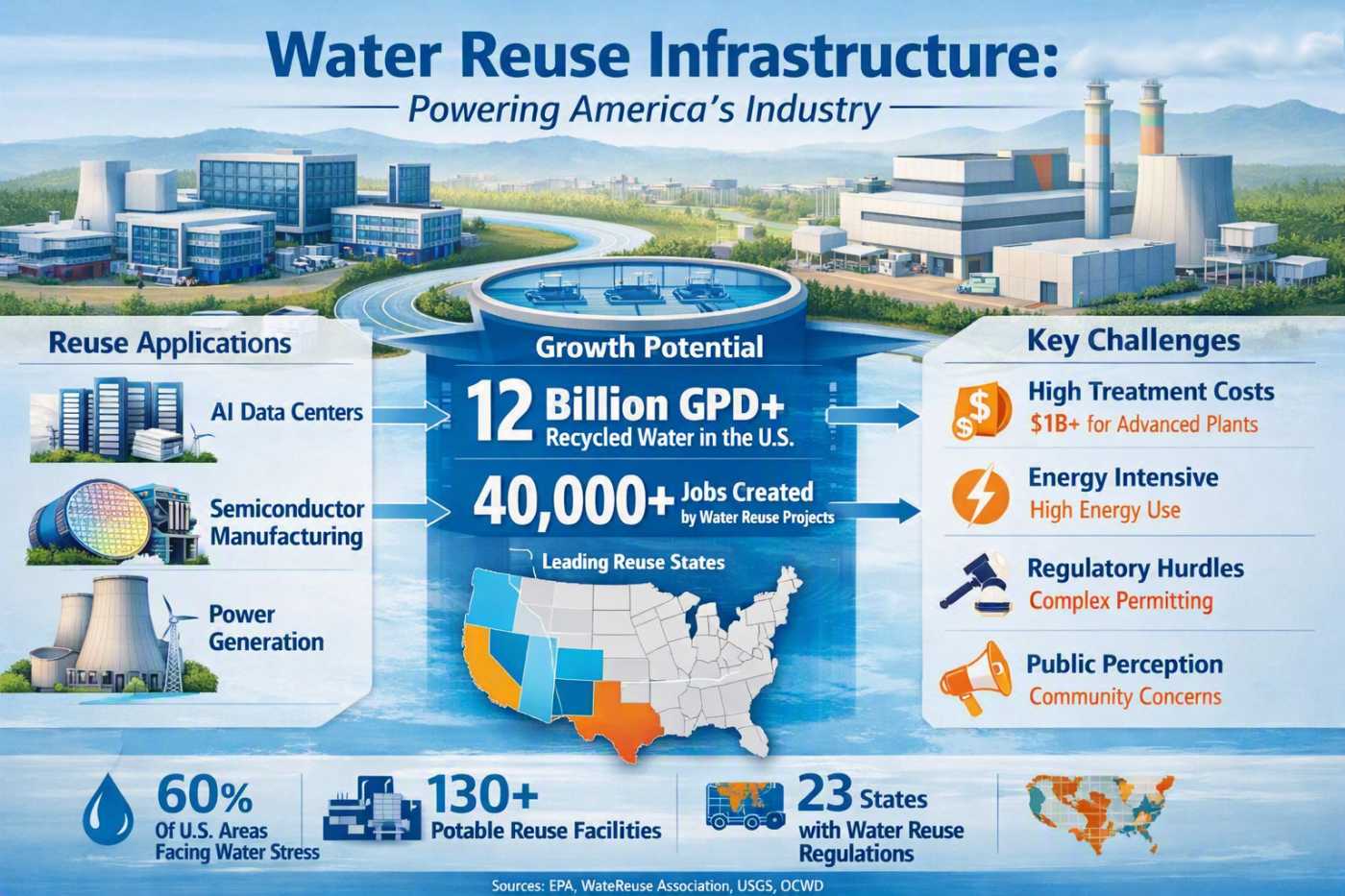
Water Reuse as Economic Infrastructure
In April 2026, the U.S. Environmental Protection Agency (EPA) launched the Water Reuse Action Plan 2.0, positioning water recycling as a cornerstone of industrial expansion. Unlike the first plan in 2020, WRAP 2.0 explicitly emphasizes reuse for AI data centers, semiconductor manufacturing, and power generation. EPA Administrator Zeldin described the initiative as unleashing “American ingenuity to grow our economy, while supporting public health and strengthening water resources.”
Industrial Drivers of Reuse
Water-intensive industries are at the heart of WRAP 2.0. Data centers require vast cooling systems; semiconductor fabs consume millions of gallons of ultra-pure water daily; and power plants rely on steady supplies for cooling and steam cycles. The EPA’s plan includes a GIS-based mapping tool to identify reuse opportunities for power plants and new permitting frameworks for recycled water in data center cooling.
University and Utility Research
Universities and engineering institutes have reinforced this vision. Stanford’s Water in the West program has shown that advanced treated wastewater can meet industrial purity standards, while Arizona State University researchers highlight how reuse reduces dependence on dwindling Colorado River allocations. Utilities like the Orange County Water District (OCWD) have demonstrated large-scale potable reuse, producing over 100 million gallons per day of purified water, proving technical feasibility for industrial adoption.
Economic Infrastructure Analogy
The distinctive angle of WRAP 2.0 is treating water reuse as economic infrastructure comparable to electricity transmission. Just as regions with reliable power grids attract manufacturing, regions with robust water-recycling systems may gain an industrial edge. EPA Assistant Administrator Jess Kramer noted, “Our nation’s water needs are changing rapidly thanks to manufacturing growth and the AI revolution. Water reuse has never been more important.”
Technical Constraints
- Treatment Standards: Semiconductor and pharmaceutical industries require ultra-pure water. Advanced membrane bioreactors and reverse osmosis systems must be scaled to meet these standards.
- Energy Intensity: High-grade treatment consumes significant energy, raising questions about carbon footprints.
- Distribution Infrastructure: Separate pipelines for recycled water add capital costs, particularly in retrofitting existing industrial zones.
Economic and Regulatory Barriers
- Capital Costs: Building advanced treatment plants can exceed $1 billion, challenging municipalities without federal support.
- Regulatory Fragmentation: States vary in permitting recycled water for industrial use. California leads, but others lag due to unclear standards.
- Financing Models: Public-private partnerships are emerging, but long-term cost recovery remains uncertain.
Public Acceptance Challenges
Although industrial reuse avoids the “toilet-to-tap” stigma of potable reuse, public perception still matters. Communities often resist siting advanced treatment plants due to concerns about odors, safety, or property values. EPA’s WRAP 2.0 includes outreach initiatives to normalize reuse as a mainstream infrastructure investment.
Regional Competitiveness
Regions with strong reuse systems may attract industries constrained elsewhere. For example, Texas utilities are piloting reuse for data centers, while Arizona’s reuse programs are pitched as a solution to Colorado River shortages. In contrast, states dependent on freshwater withdrawals face mounting limits, potentially deterring industrial investment.
Future Outlook
WRAP 2.0 signals a paradigm shift: water reuse is no longer framed as conservation but as strategic industrial infrastructure. If successful, it could redefine regional competitiveness, much like electrification did in the 20th century. The challenge lies in overcoming technical, economic, and social barriers to scale reuse nationwide.