business
The Repair Economy Boom in Rural America
A detailed feature on how small-town hardware stores in the American Midwest are reinventing themselves as circular economy hubs, boosting foot traffic and partnering with municipalities to reduce waste while building profitable, community-driven business models.





The Unexpected Reinvention of the Midwest Hardware Store
Across the American Midwest, a quiet transformation is reshaping the role of the local hardware store. Long seen as utilitarian retail spaces places to pick up nails, paint, or a last-minute wrench these stores are emerging as unlikely leaders in circular economy innovation. As of May 2026, a growing number of small-town, family-owned hardware businesses are turning repair, reuse, and community collaboration into both a profitable model and a civic service.
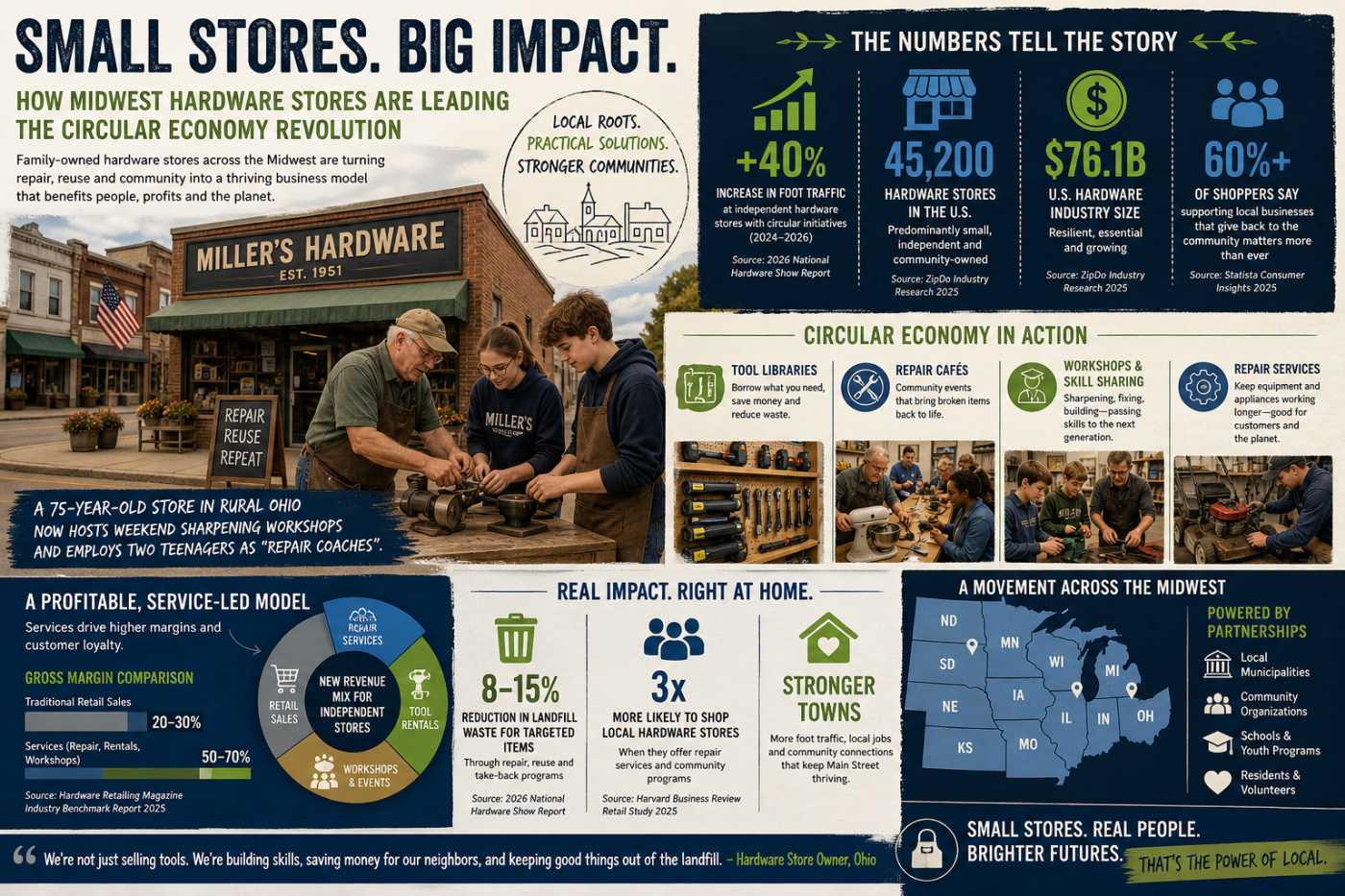
According to the 2026 National Hardware Show report, foot traffic at independent hardware stores experimenting with circular economy initiatives has increased by nearly 40 percent over the past two years. The report, compiled by industry analysts and retail researchers affiliated with the National Hardware Show, highlights a shift that blends old-fashioned service with modern sustainability practices. Rather than competing head-on with big-box retailers on price or scale, these stores are redefining value through community engagement and longevity.
This evolution is not being driven by environmental urgency alone. Instead, it reflects a pragmatic, community-rooted approach to commerce one that aligns economic incentives with local needs. In towns where budgets are tight and resources are valued, the idea of repairing rather than replacing has always carried intuitive appeal. What has changed is how deliberately these practices are being structured, monetized, and scaled.
From Retail Space to Resource Hub
At the heart of this transformation is a simple idea: a hardware store can be more than a place to buy tools it can be a place to share them. Tool libraries, once confined to urban cooperative spaces, are now finding fertile ground in Midwestern towns. Customers can borrow specialized tools tile cutters, power washers, post-hole diggers for a fraction of the purchase cost. For store owners, this model generates recurring revenue while deepening customer relationships.
Municipal partnerships have played a crucial role in accelerating this trend. Local governments, facing mounting landfill costs and sustainability targets, are increasingly collaborating with hardware stores to pilot waste-reduction programs. These partnerships often involve small grants, shared marketing efforts, or logistical support for community events such as repair cafes.
Repair cafes informal gatherings where residents bring broken items to be fixed with the help of volunteers or store staff have become a cornerstone of this movement. Hosted in parking lots, backrooms, or adjacent community spaces, these events blend education with commerce. Participants often purchase parts or tools during the process, creating a direct revenue stream while reinforcing the store’s role as a trusted advisor.
The result is a hybrid business model that combines retail, service, and community engagement. It is not a radical departure from the past, but rather an extension of the traditional hardware store ethos helping customers solve problems into new domains.
A 75-Year-Old Store Finds New Life in Ohio
In rural Ohio, one hardware store offers a compelling example of how this transformation is unfolding on the ground. Established in the early 1950s, the store has been a fixture in its community for three generations. For decades, its business model remained largely unchanged: a steady stream of local customers, a carefully curated inventory, and a reputation built on personal service.
In 2024, facing declining margins and increased competition from regional chains, the store’s current owner decided to experiment with new ways to attract customers. The idea was not to overhaul the business, but to build on its existing strengths. The first initiative was a weekend sharpening workshop, where customers could bring in dull knives, garden tools, and lawn equipment for professional sharpening.
The response exceeded expectations. What began as a modest service quickly evolved into a social event. Customers lingered, exchanged tips, and often purchased additional items. Encouraged by the turnout, the store expanded its offerings to include basic repair workshops, focusing on small appliances, hand tools, and outdoor equipment.
Today, the store employs two local teenagers as “repair coaches.” Trained on-site, they assist customers during workshops, diagnose common issues, and guide participants through the repair process. For the teenagers, the role provides not only income but also valuable technical skills. For the store, it adds a layer of energy and relatability that resonates with younger customers.
The impact on the business has been tangible. Weekend foot traffic has doubled, and weekday sales have seen a measurable uptick as workshop participants return for supplies. More importantly, the store has repositioned itself as a community hub a place where knowledge is shared and relationships are built.
Municipal Partnerships and Waste Reduction
The collaboration between hardware stores and local governments is emerging as a defining feature of this trend. Municipalities across the Midwest are under increasing pressure to manage waste more efficiently. Landfill capacity is finite, and disposal costs continue to rise. By supporting repair and reuse initiatives, local governments can extend the life of consumer goods and reduce the volume of waste entering the system.
Programs vary by region, but common elements include co-sponsored repair events, public awareness campaigns, and small financial incentives for participating businesses. In some towns, residents receive vouchers for attending repair workshops, which can be redeemed for store credit. In others, municipalities provide logistical support, such as mobile units for collecting and transporting items.
The 2026 National Hardware Show report notes that these partnerships have led to measurable outcomes. Participating communities have reported reductions in landfill contributions ranging from 8 to 15 percent for targeted categories such as small appliances and garden equipment. While these figures may seem modest, they represent significant savings at the municipal level.
For hardware stores, the benefits extend beyond increased foot traffic. Municipal partnerships lend credibility and visibility, positioning these businesses as integral contributors to local sustainability efforts. This alignment with public policy goals creates a virtuous cycle: as stores attract more customers, they generate more data and success stories, which in turn attract further support.
The Economics of Repair and Reuse
What makes this model particularly compelling is its economic viability. Unlike many sustainability initiatives that rely heavily on subsidies or goodwill, the circular economy practices adopted by hardware stores are proving to be self-sustaining. Revenue streams include tool rentals, workshop fees, repair services, and incremental product sales.
Margins on services are often higher than those on retail goods, providing a buffer against price competition from larger chains. Additionally, the recurring nature of these services customers returning for maintenance, upgrades, or new projects creates a more stable revenue base.
The nearly 40 percent increase in foot traffic reported in 2026 is not merely a statistic; it reflects a shift in consumer behavior. Customers are seeking experiences and expertise, not just products. They value the ability to learn, to fix, and to extend the life of their possessions. In this context, the hardware store becomes a destination rather than a transactional stop.
This shift also has implications for inventory management. Stores are increasingly stocking parts, components, and repair kits alongside traditional items. This diversification not only supports the repair ecosystem but also differentiates independent stores from big-box competitors, which often prioritize high-volume, standardized products.
Why Big-Box Retailers Are Struggling to Replicate It
Large retail chains have taken notice of these developments, but replicating them at scale has proven challenging. The strength of the small-town hardware store lies in its embeddedness within the community. Owners know their customers personally, understand local needs, and can adapt quickly to changing conditions.
Big-box retailers, by contrast, operate on standardized models designed for efficiency and consistency. While they excel at logistics and pricing, they often lack the flexibility and local knowledge required to implement community-driven initiatives. Hosting a repair cafe or managing a tool library requires a level of customization and human interaction that does not easily fit into a centralized corporate structure.
Moreover, the economics of large-scale retail are not always aligned with repair and reuse. Selling new products at volume remains the primary revenue driver. Encouraging customers to repair existing items can, in some cases, conflict with this model. For independent hardware stores, however, the equation is different. Their success depends on relationships, trust, and repeat visits factors that are strengthened by circular economy practices.
A Quiet Model of Sustainable Commerce
What is perhaps most striking about this trend is its understated nature. There are no sweeping घोषणाएँ or dramatic pivots. Instead, there is a steady accumulation of small, practical changes each grounded in the realities of local economies. The result is a model of sustainable commerce that is both resilient and replicable.
Industry observers note that this approach resonates particularly well in the Midwest, where values such as thrift, self-reliance, and community cooperation are deeply ingrained. By aligning with these values, hardware stores are not only staying relevant but also strengthening their role within the social fabric.
The involvement of younger generations, as seen in the Ohio store’s “repair coaches,” suggests that this model has the potential to endure. As skills are passed down and adapted, the line between customer and contributor begins to blur. Participants become advocates, and advocates become regulars.
In a retail landscape often dominated by scale and speed, the resurgence of the small-town hardware store offers a different narrative one that prioritizes depth over breadth. It is a story of businesses that have found growth not by expanding outward, but by digging deeper into their communities.
As the 2026 National Hardware Show report indicates, the numbers support this shift. Increased foot traffic, diversified revenue streams, and measurable environmental benefits all point to a model that works. Yet its true significance may lie in something less quantifiable: the restoration of a sense of place and purpose in everyday commerce.