Good prospects:
Latest Regulatory Filings for SP5
Companies with the best and the worst fundamentals.
Why Community Colleges Are Winning Again

The Liquidity Trap Hidden Inside Leveraged ETFs

SpaceX IPO Spawned a New Speculation Machine
How SpaceX Gave Main Street a Seat at the IPO
How Workers Became Capitalists
The Apartment Glut Changing America’s Rental Market


The Apartment Boom That Finally Benefited Renters
For much of the past decade, Americans have become accustomed to a frustrating pattern: construction costs rise, housing prices rise, rents rise, and households are left wondering why more building never seems to translate into meaningful savings. In 2026, however, the U.S. rental market is experiencing one of the clearest examples in recent memory of supply-and-demand economics working in consumers' favor.
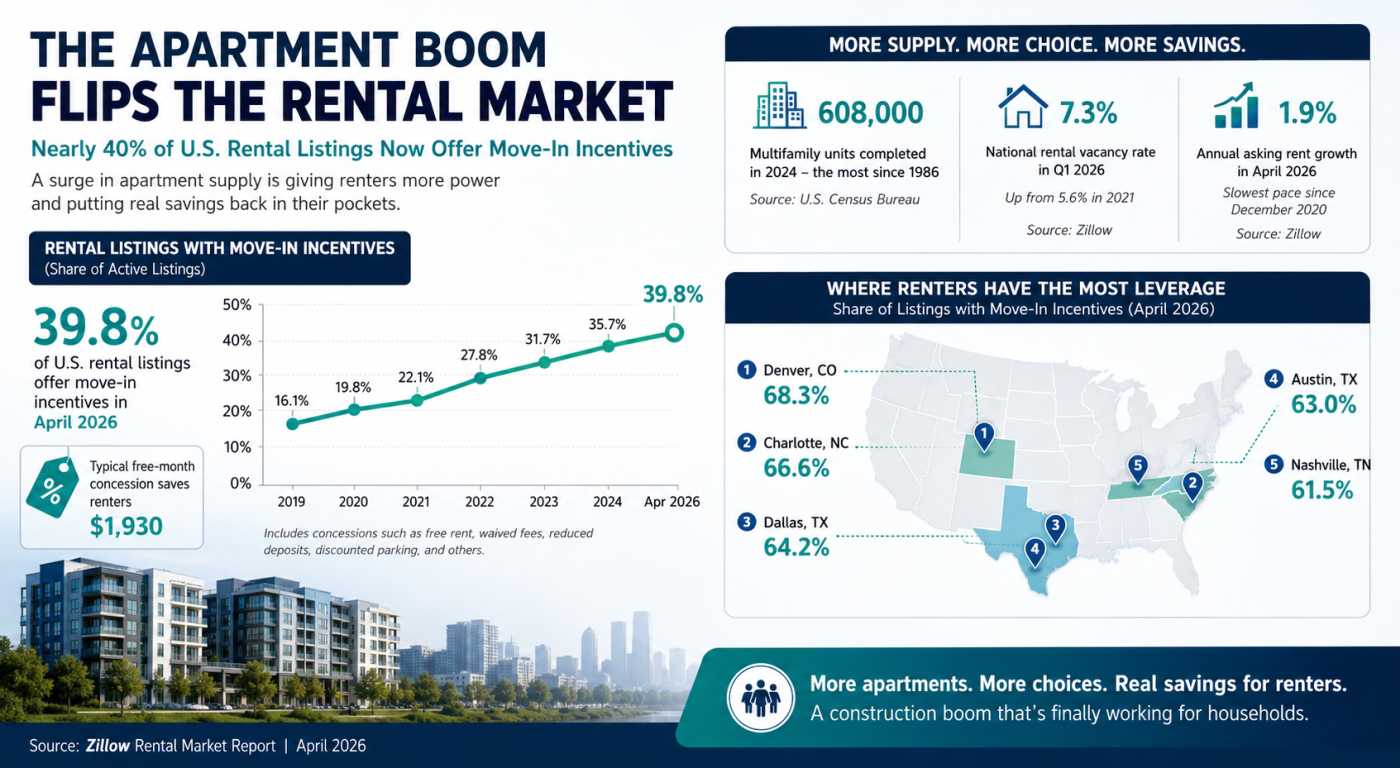
A historic wave of apartment construction has dramatically altered the balance of power between landlords and renters. According to Zillow's April 2026 Rental Market Report, 39.8% of rental listings nationwide now include concessions such as free rent, waived application fees, reduced security deposits, discounted parking, or other move-in incentives. That is the highest share ever recorded for this time of year and more than double the pre-pandemic level.
The development is remarkable not only because renters are receiving discounts, but because it represents a rare case where a construction boom has produced direct household savings rather than inflationary pressure. Instead of developers merely benefiting from higher property values, renters themselves are capturing part of the economic gain through lower effective housing costs.
A Record-Breaking Supply Surge Changes the Market
The roots of today's renter-friendly conditions can be traced back several years. During the pandemic-era housing frenzy, developers rushed to break ground on apartment projects across the country, particularly in fast-growing Sun Belt markets. Those projects have now been completed and delivered into the market in large numbers.
Zillow reports that the resulting inventory expansion has pushed the national rental vacancy rate to 7.3%, up significantly from 5.6% in 2021 when rental competition was exceptionally intense. The increase may appear modest, but in housing economics, even small changes in vacancy rates can dramatically shift bargaining power.
When vacancies are low, landlords can often raise rents aggressively because prospective tenants have few alternatives. When vacancies rise, every empty unit becomes a revenue problem for property owners. Suddenly, landlords must compete for tenants rather than the other way around.
The construction surge has been substantial by historical standards. Multifamily completions reached approximately 608,000 units in 2024, the highest annual total since 1986 according to housing industry data cited by market researchers. Those newly completed apartments continue to flow through local markets, creating an unusually competitive leasing environment in 2026.
Why Concessions Matter More Than Rent Cuts
One of the most interesting aspects of the current market is that many landlords are choosing concessions instead of outright rent reductions.
At first glance, offering a free month of rent may seem economically equivalent to lowering the monthly rental rate. In practice, however, concessions allow property owners to preserve headline pricing while still providing meaningful savings to renters.
A landlord advertising a $2,000-per-month apartment with one month free on a 12-month lease effectively reduces the annual housing cost by more than 8%. Yet the advertised rent remains $2,000, helping maintain property valuations and avoiding the negative signaling effects associated with formal rent reductions.
This explains why incentives have become so widespread. Property managers can fill units faster while preserving pricing metrics that investors, lenders and appraisers closely monitor.
Zillow economist Kara Ng summarized the shift succinctly, stating that: "Renters are in a position to push for a better deal, and property managers are ready to give them one." The comment captures a dynamic that would have seemed unlikely during the overheated rental markets of 2021 and 2022.
Where Renters Hold the Most Power
The renter-friendly environment is not evenly distributed across the country. The largest concessions tend to appear in markets that experienced the most aggressive apartment construction.
According to Zillow's research, Denver leads major U.S. markets with 68.3% of rental listings offering concessions. Charlotte follows at 66.6%, while Dallas stands at 64.2%. Austin, Nashville and several other high-growth Sun Belt cities also rank near the top.
The pattern is not accidental. These metropolitan areas welcomed enormous volumes of new apartment inventory during the past several years. Developers anticipated continued population growth and robust housing demand. While demand remains healthy, supply has grown even faster.
The result is a highly competitive leasing environment where landlords frequently offer free rent, waived fees and other incentives to attract tenants.
By contrast, tighter housing markets continue to exhibit landlord-friendly characteristics. Zillow reports that concession rates remain comparatively low in cities such as Buffalo, Providence and New York, where housing supply constraints continue to limit vacancy growth.
This regional divergence highlights an important lesson: housing affordability often depends less on demand strength than on supply responsiveness. Cities that build more housing generally experience less upward pressure on rents over time.
The Hidden Savings for Households
The immediate financial impact on renters can be significant.
Zillow estimates that the typical free-month concession translates into roughly $1,930 in savings for renters. For many households, that amount represents more than a monthly mortgage payment, several months of groceries, a meaningful emergency fund contribution, or a substantial reduction in moving expenses.
Importantly, these savings arrive at a time when housing affordability remains a major national concern. Even though rent growth has cooled dramatically, housing costs still consume a large share of household budgets.
Zillow's data indicates that national asking-rent growth slowed to approximately 1.9% year-over-year in early 2026, representing the slowest pace since late 2020. While rents are not broadly falling nationwide, the deceleration itself provides meaningful relief after years of rapid increases.
The combination of slower rent growth and widespread concessions effectively creates a double benefit for renters. Monthly housing costs are rising more slowly, while upfront leasing costs are often falling.
A Rare Economic Success Story
The apartment market's transformation offers an unusually clear demonstration of how additional supply can improve affordability.
Public debates about housing frequently focus on demand-side solutions such as subsidies, tax credits or rent controls. While each approach has supporters and critics, the current rental environment shows what can happen when large quantities of new housing are actually delivered to the market.
The impact is visible not only in rent growth statistics but also in landlord behavior. The fact that nearly two out of every five listings now include incentives suggests that owners recognize the increased bargaining power of renters.
Few industries produce such visible consumer benefits from expanded production. When new supply enters many sectors, producers often retain much of the economic gain through higher margins. In the apartment market, however, vacant units generate no rental income. As supply expands, landlords must compete aggressively for occupancy, forcing more of the benefit toward consumers.
That makes the current situation noteworthy from both an economic and policy perspective. It demonstrates that increased housing production can create measurable savings for ordinary households within a relatively short timeframe.
Why the Window May Not Stay Open Forever
Although renters currently enjoy some of the strongest negotiating leverage in years, market observers caution that today's conditions may not persist indefinitely.
The same factors that generated the construction boom are beginning to reverse. Higher interest rates, tighter financing conditions, rising labor expenses and elevated construction costs have significantly reduced new apartment starts compared with peak levels.
Several industry analyses suggest that the development pipeline is thinning. As fewer projects begin construction, the pace of future apartment deliveries is expected to moderate. Eventually, demand growth could absorb existing vacancies and restore pricing power to landlords.
Some regional data already hint at this possibility. In certain markets, newly completed apartments are leasing faster than they were a year ago. The market remains renter-friendly overall, but the supply surge that created these conditions is no longer accelerating.
For now, however, the inventory already delivered continues to shape leasing conditions across much of the country.
The Broader Housing Lesson
The most important takeaway from the 2026 rental market may extend beyond apartments themselves.
For years, economists argued that increasing housing supply would eventually improve affordability. Critics often pointed out that new luxury developments appeared disconnected from the financial realities facing average renters. The current market offers evidence that even market-rate construction can influence affordability when enough units are added.
As higher-income renters move into newly constructed buildings, older housing stock becomes available to other households. Combined with direct competition among landlords, the process can soften rent growth across broader segments of the market.
The result is not a dramatic collapse in housing costs. Rather, it is a gradual but meaningful shift in negotiating power. Renters gain more choices, landlords offer more incentives, vacancy rates normalize, and housing costs become somewhat less burdensome.
That may sound modest, but in an era when housing affordability dominates economic discussions, it represents something increasingly rare: a construction boom whose benefits are showing up directly in household budgets. At a moment when nearly 40% of rental listings include concessions and rent growth is running at its slowest pace in years, millions of Americans are experiencing what happens when supply finally catches up with demand.
If you have enjoyed reading, spread the word:
The Inflation Wave the Fed Can't Navigate

The Biggest IPO Year Ever: Can Markets Absorb It?
The Jobs Report That Crashed the Rally

The Fed Study Revealing Tomorrow's Investment Themes