business
NITI Blueprint Could Turn Brain Drain Into $135Bn Engine
Analysis of NITI Aayog's May 2026 working paper proposing state-led overseas employment systems, examining how structured migration pipelines could transform India's remittance economy and address youth unemployment.





On May 20, 2026, NITI Aayog released a landmark working paper titled ‘States’ Framework: Advancing International Worker Mobility for Skilled Workers,’ which proposes a structural overhaul of how Indian states approach overseas employment. The document argues for a shift from fragmented informal networks to state-run recruitment agencies, foreign-language training programmes, and digital dashboards that track real-time global labour demand .
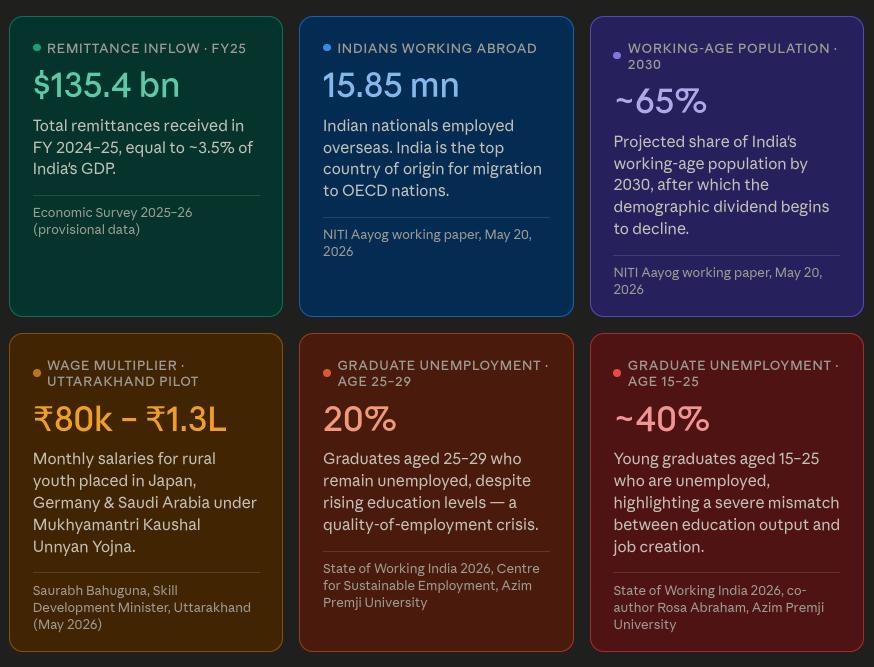
This blueprint arrives at a critical juncture. With 15.85 million Indians already working abroad and India ranking as the top country of origin for migration to OECD nations, the paper suggests states should treat overseas employment as an economic development strategy rather than a mere safety valve. The question is whether this structured approach can transform the current brain drain into a brain gain that serves as India's next big remittance engine.
The Stakes: Remittances as an Economic Anchor
The economic weight of India's diaspora is staggering. According to the Economic Survey 2025-26, India's remittance inflows reached USD 73 billion in the first half of FY26, compared to USD 64.7 billion in the same period last year. Over the longer term, provisional data shows remittance inflows increasing steadily from USD 55.6 billion in FY11 to USD 135.4 billion in FY25, accounting for approximately 3.5 per cent of GDP .
The Survey notes that these transfers have consistently financed a substantial portion of the merchandise trade deficit and have exceeded gross foreign direct investment inflows in most years. This is not merely a financial footnote it is a structural pillar of India's external-sector resilience. However, the NITI Aayog paper argues that this pillar remains under-engineered, relying too heavily on informal networks that leave workers vulnerable to exploitation and limit the potential per-capita remittance value.
From Fragmented Pipelines to State-Led Ecosystems
The core of the NITI Aayog proposal is the creation of what it calls "a structured, scalable, and inclusive approach" that links skill development directly with international employment opportunities. The paper explicitly states that "with a structured, scalable, and inclusive approach, states can unlock the full potential of international mobility, to serve individual aspirations and to advance local economic development, employment generation" .
This is not merely an aspirational document. The framework includes concrete recommendations: states should create digital platforms within nodal departments that consolidate data on worker mobility and integrate with national systems such as eMigrate and the National Career Service (NCS) portal. "Integrate the dashboard with eMigrate and NCS to ensure alignment with national systems," the paper advises, urging states to use these platforms "for planning, performance reviews, and targeted outreach" .
Perhaps most significantly, the paper recommends upgrading Industrial Training Institutes (ITIs), polytechnics, and other skilling centres into hubs for international placements. "These institutions must be purpose-designed to provide intensive, employer-aligned training that upgrades workers’ technical competencies while addressing the specific requirements of destination country labour markets," the paper adds . This represents a fundamental reorientation from training for domestic informal employment to preparing for formal, regulated overseas positions.
Early Adopters: Evidence from the States
The NITI Aayog proposal is not凭空出现. Some states have already begun experimenting with similar models, providing early evidence of what works. Uttarakhand, for instance, has been operating the Mukhyamantri Kaushal Unnyan Evam Vaishvik Rozgar Yojna since 2023. According to state skill development minister Saurabh Bahuguna, 143 youth have received training under the scheme so far, of whom 92 have secured jobs in countries such as Japan, Germany, and Saudi Arabia. Their monthly salaries range from Rs 80,000 to Rs 1.3 lakh .
Currently, 541 candidates are undergoing training at the Doon University centre in Dehradun, where they are taught foreign languages including German, French, and Spanish, along with English. Food and lodging facilities are provided free of cost to trainees. The state has announced it will open a similar centre in Almora . This model aligns directly with the NITI Aayog recommendation to subsidise foreign-language training and certification for workers from lower-income backgrounds, with targeted support for marginalised groups.
What makes the Uttarakhand experiment notable is not just the placement numbers but the wage outcomes. Monthly salaries of Rs 80,000-1.3 lakh significantly exceed what most rural workers could earn in domestic informal employment. This wage premium is precisely the economic multiplier the NITI Aayog paper hopes to scale.
The Demographic Imperative
The urgency of the NITI Aayog proposal is underscored by India's demographic trajectory. The working paper notes that India's working-age population is projected to reach around 65 per cent by 2030 before gradually declining . This aligns with findings from the ‘State of Working India 2026’ report published by the Centre for Sustainable Employment at Azim Premji University. Rosa Abraham, the report's lead author and Associate Professor of Economics at Azim Premji University, notes that India's demographic dividend the ratio of working-age people to dependents is peaking around 2030 .
However, the same report documents a striking paradox: even as educational attainment has expanded dramatically, the transition to stable, gainful employment remains uncertain. Graduate unemployment among 15- to 29-year-olds remains high nearly 40 per cent among the 15- to 25-year-olds, and 20 per cent among the 25- to 29-year-olds and only a small share secure stable salaried jobs within a year of graduation .
As Rosa Abraham told The Hindu in an interview, "We are not producing enough jobs for the number of educated workers we have. If we compare with countries at similar levels of development, India's tertiary enrolment rates are on par. So, in that sense, no, we are not 'overproducing' graduates. We are underproducing good jobs" . The NITI Aayog framework offers one answer to this mismatch: create pathways for these educated workers to access good jobs in ageing economies facing labour shortages.
Beyond Remittances: The Circular Migration Multiplier
The NITI Aayog paper goes beyond simply maximising remittance flows. It explicitly advocates for "circular migration" models that allow workers to return home periodically while maintaining employment relationships. "Agreements should incorporate provisions for 'circular migration' models that allow workers to return home periodically while maintaining employment relationships, thereby facilitating knowledge transfer and investment in origin communities," the paper notes .
This is a sophisticated intervention in migration theory. Traditional remittance-focused policies treat workers as permanent exporters of labour. Circular migration, by contrast, recognises that workers who return with savings, skills, and international exposure can become entrepreneurs, trainers, and investors in their home communities. The multiplier effect extends beyond the remittance itself to the human capital and social capital that returns with the worker.
The paper also recommends that states negotiate direct agreements with foreign employers and industries to co-design training, clarify job requirements, and create predictable recruitment pipelines. These agreements should include worker safeguards such as wage protection, safe recruitment practices, insurance, grievance redress, and support systems abroad . This bilateral framework would replace the current system where workers navigate a fragmented landscape of private agents, often paying exorbitant fees for uncertain outcomes.
Addressing the Quality-Employment Crisis
The timing of the NITI Aayog paper is significant because India is facing what economists describe as a quality-of-employment crisis, not merely a quantity problem. As Rosa Abraham noted, "It is both a quality and quantity problem. As co-author Amit Basole indicates, skills don't create jobs; jobs create skills. So, if the demand for jobs were present, then the right kinds of education or training and skilled workforce would also manifest with time" .
The NITI Aayog framework essentially argues that states can create demand for skills by connecting domestic training infrastructure to international labour markets. By identifying sectors with the highest overseas labour demand and aligning district-level skilling capacity accordingly, states can provide a clear signal to workers and training institutions about which skills will generate economic returns. This demand-led model contrasts sharply with the supply-driven approach that has dominated Indian skill development to date.
The paper's recommendation that ITIs and polytechnics be "purpose-designed to provide intensive, employer-aligned training" suggests a fundamental rethinking of vocational education. Instead of generic certifications that have limited market value, these institutions would offer curricula co-designed with foreign employers, including language training, cultural orientation, and technical skills tailored to specific destination-country requirements.
Women's Migration: A Neglected Frontier
One of the more progressive elements of the NITI Aayog paper is its attention to women's migration. The paper explicitly calls for states to "create secure, regulated recruitment and training pathways for women migrants engaging only verified employers who provide safe accommodation and workplace conditions." It also recommends maintaining "dedicated women-specific helplines and mentorship networks" .
This is not merely a social justice provision it is economic pragmatism. The ‘State of Working India 2026’ report found that young women are increasingly employed in IT, automobile manufacturing, and business services, but their workforce participation remains constrained by safety concerns, mobility restrictions, and lack of institutional support . By creating structured pathways for female migrants, states can tap a significantly underutilised segment of the workforce while also increasing household-level remittance income.
The Digital Infrastructure Layer
The NITI Aayog proposal places considerable emphasis on digital infrastructure. The recommended dashboard would consolidate data on worker mobility, track real-time global labour demand, and integrate with national systems. The paper suggests that states should "share shortlisted profiles with employers for evaluation through virtual or in-person interviews, practical demonstrations, or task-based assessments, allowing employers to validate competencies directly and assess workplace fit" .
This digital layer addresses a critical market failure: information asymmetry. Currently, workers have limited visibility into genuine job opportunities, wage expectations, or employer reliability. Employers, meanwhile, have no efficient mechanism to identify and vet workers from specific regions of India. A state-run digital platform, integrated with visa processing and pre-departure orientation, could dramatically reduce transaction costs and fraud.
The paper also calls for "faster and standardised pre-departure processing of documents like passports, medicals and skill certifications, along with uniform CVs and credentials aligned to destination-country requirements." It suggests "liaison arrangements with destination-country embassies to support standardised visa application processing" and facilitating "bulk or group visa submissions through bilateral channels" . These are operational details that distinguish a serious policy framework from aspirational rhetoric.
Political Economy and Implementation Challenges
While the NITI Aayog paper is analytically sound, its implementation will face significant political economy challenges. State-run recruitment agencies would compete directly with a sprawling private recruitment industry, which has significant local political influence. The paper attempts to address this by recommending that states "negotiate direct agreements with foreign employers," effectively bypassing the existing agent network. Whether state governments have the administrative capacity and political will to do so remains an open question.
Additionally, the fiscal implications are non-trivial. Subsidising foreign-language training, certification examinations, and study materials for workers from lower-income backgrounds requires upfront investment. States with limited fiscal space may struggle to implement the framework without central government support. The paper does not specify funding mechanisms, leaving this as a potential sticking point.
Nevertheless, the early evidence from Uttarakhand suggests that the model can work at scale. The state's investment in free training and lodging for 541 current trainees, and the placement of 92 workers at substantial salaries, provides a proof of concept that other states can adapt. The key will be moving from isolated pilot programmes to systematic state-level infrastructure.
A New Narrative for Migration
The NITI Aayog paper represents a paradigm shift in how Indian policymakers discuss overseas employment. For decades, migration was framed as a distress-driven phenomenon a safety valve for a domestic economy that could not generate sufficient jobs. The new framework reframes overseas employment as a deliberate economic development strategy, one that can generate higher per-capita remittance value, upskill rural workforces before they leave, and reduce youth unemployment without waiting for domestic job creation to catch up with India's demographic dividend.
With 15.85 million Indians already working abroad and remittances accounting for 3.5 per cent of GDP, the potential for structured migration pipelines is enormous. The question is no longer whether India should facilitate overseas employment, but whether its states can build the institutional infrastructure to do so systematically, transparently, and at scale. The NITI Aayog working paper provides the blueprint. The next move belongs to the states.