business
India's Grid-Scale Storage Revolution 2026
A detailed analysis of India's energy storage surge in 2026, highlighting how grid-scale battery projects are creating new business ecosystems and attracting investors to treat battery infrastructure as a standalone asset class.





The Rise of Energy Storage in India's Investment Landscape
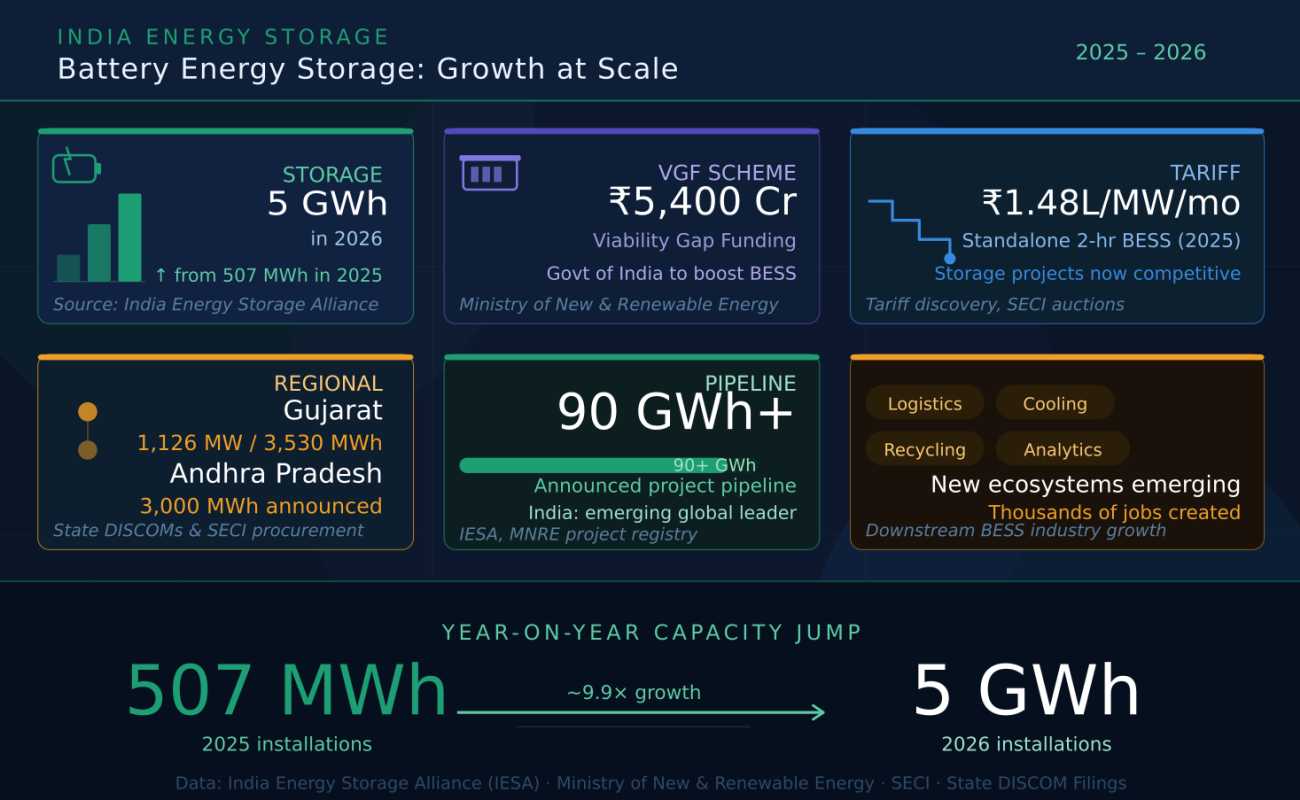
India's energy sector in 2026 is witnessing a profound transformation, with grid-scale battery energy storage systems (BESS) emerging as a standalone asset class. According to the India Energy Storage Alliance (IESA), installations are expected to surge nearly tenfold from 507 MWh in 2025 to 5 GWh in 2026. This marks a critical inflection point where years of tendering activity are finally translating into operational projects, reshaping the country's energy and infrastructure ecosystem. [IBEF](https://www.ibef.org/news/india-s-energy-storage-projects-installation-to-surge-10-fold-to-5gwh-in-2026) [ET EnergyWorld](https://energy.economictimes.indiatimes.com/news/power/indias-energy-storage-capacity-to-surge-by-10-fold-to-5gwh-in-2026/126373565)
Policy Push and Market Dynamics
The Government of India has catalyzed this growth through initiatives such as the Viability Gap Funding (VGF) scheme worth Rs 5,400 crore and waivers on interstate transmission charges. The Central Electricity Regulatory Commission has also begun adopting tariffs for renewable projects paired with storage, while the Central Electricity Authority has strengthened technical frameworks for integrating advanced systems like grid-forming inverters. These measures have made BESS projects financially viable and bankable, encouraging investors to treat them as infrastructure assets rather than experimental ventures. [thebatterymagazine.com](https://www.thebatterymagazine.com/bess-projects-india-2026-update-from-announcements-to-actual-deployment/)
Investment Activity and Asset Class Evolution
Investors are increasingly viewing battery infrastructure as a distinct asset class. The collapse of tariffs in 2025, with standalone 2-hour BESS tariffs dropping to ₹1.48 lakh/MW/month, has intensified competition and attracted new entrants. By 2026, over 60 GWh of projects are entering the implementation phase, with landmark developments such as Adani's 1,126 MW/3,530 MWh project in Gujarat and Rajasthan's large solar-plus-storage initiatives. These projects are not only stabilizing India's renewable-heavy grid but also creating new business ecosystems around logistics, cooling systems, maintenance, recycling, and software analytics. [ET EnergyWorld](https://energy.economictimes.indiatimes.com/news/power/indias-energy-storage-capacity-to-surge-by-10-fold-to-5gwh-in-2026/126373565)
Regional Opportunities: Western and Southern India
Western India, particularly Gujarat and Rajasthan, is leading the charge. Gujarat has approved large standalone BESS capacities, while Rajasthan is deploying storage to reduce curtailment of its massive solar output. In Southern India, Andhra Pradesh has outlined a 3,000 MWh storage plan to reduce peak power costs, and Tamil Nadu is exploring hybrid renewable-storage projects to stabilize its industrial-heavy grid. These regions are becoming focal points for investment, offering opportunities for startups and established firms alike to build ancillary businesses around the storage ecosystem. [thebatterymagazine.com](https://www.thebatterymagazine.com/bess-projects-india-2026-update-from-announcements-to-actual-deployment/)
Emergence of Local Business Ecosystems
The rise of grid-scale storage is spawning entirely new local business ecosystems:
- Logistics: Specialized transport for large battery modules and components.
- Cooling Systems: Advanced thermal management solutions to ensure battery efficiency and safety.
- Maintenance: Service providers offering predictive maintenance and rapid-response teams for large installations.
- Recycling: Emerging firms focusing on end-of-life battery recovery and material reuse.
- Software Analytics: Startups developing AI-driven platforms for performance optimization, predictive failure detection, and market bidding strategies.
Indian Startups, Utilities, and Manufacturing Firms
Indian startups are increasingly active in the storage sector, with companies like Juniper Green Energy pioneering merchant BESS installations. Utilities are integrating storage into their renewable portfolios, while manufacturing firms are scaling up production of battery modules and components. The synergy between policy support, private capital, and entrepreneurial innovation is positioning India as a hub for energy storage technologies in the global market. [ET EnergyWorld](https://energy.economictimes.indiatimes.com/news/power/indias-energy-storage-capacity-to-surge-by-10-fold-to-5gwh-in-2026/126373565)
Global Positioning and Investor Confidence
India's rapid deployment of BESS projects is attracting global attention. With a pipeline exceeding 90 GWh of announced projects, the country is demonstrating its ability to move from policy intent to real-world execution. International investors are increasingly confident in India's renewable integration roadmap, treating battery-linked infrastructure as a reliable and scalable investment opportunity. This confidence is reinforced by India's ambitious decarbonization goals and its commitment to strengthening grid reliability through storage.
Outlook for 2026 and Beyond
As India's energy storage sector matures, the focus will shift from capacity addition to operational performance. The challenge lies in ensuring that projects deliver on promised efficiency and cost savings. Nevertheless, the momentum in 2026 underscores a transformative moment: battery infrastructure is no longer a supporting technology but a cornerstone of India's energy transition. The rise of storage-linked ecosystems in logistics, cooling, recycling, and analytics signals the beginning of a new industrial chapter, one that could redefine India's role in the global clean energy economy.