
Good prospects:
Latest Regulatory Filings for NSE500
Companies with the best and the worst technicals.

Apollo FY26: When Healthcare Becomes a Flywheel
NITI Blueprint Could Turn Brain Drain Into $135Bn Engine
RAINMUMBAI Turns Rain Into a Financial Asset

India’s IT Sector Faces a Historic Breaking Point

How Independent Directors Failed Rs 2,500 Crore in Value
How Rural India Outsmarted El Niño Risks


A Quiet Shift Beneath the Surface
For decades, India's rural economy has been viewed through a narrow lens: monsoon dependency, crop yields, and agricultural distress. Every El Niño forecast or global oil shock would trigger familiar anxieties about farm output, rural demand, and inflation. Yet, somewhere over the past decade, this narrative has begun to fracture not dramatically, not loudly, but steadily and structurally.
What is emerging instead is a more shock-resistant rural economy one that absorbs climatic volatility and global macro tremors with far greater resilience than before. This transformation is not the result of a single policy breakthrough or technological leap. Rather, it is the outcome of a layered evolution: income diversification, financial deepening through gold-backed lending, the stabilizing floor of Minimum Support Prices (MSP), and a quiet but powerful rise in non-farm earnings.
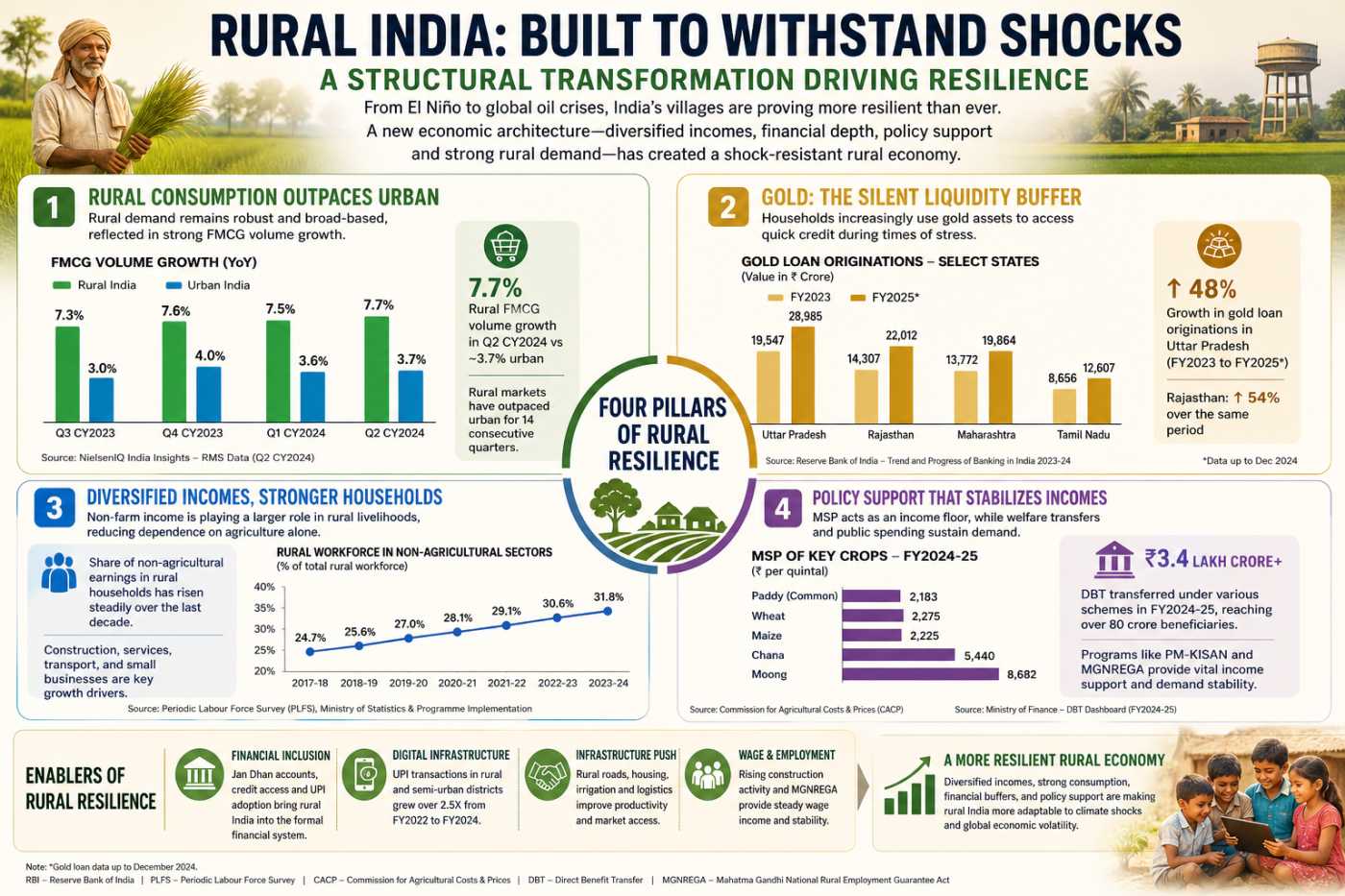
The data points are beginning to tell this story. Rural FMCG volume growth, for instance, has clocked 7.7% in recent quarters, outpacing urban demand, according to NielsenIQ's India Insights team led by Roosevelt D'Souza. This is not just a consumption story it is a resilience story.
Beyond the Monsoon Myth
The idea that rural India rises and falls with the monsoon still holds some truth but far less than it once did. In earlier decades, an El Niño year, with its deficient rainfall, could cascade into reduced sowing, lower yields, suppressed incomes, and ultimately weak consumption demand.
Today, that chain reaction is increasingly interrupted.
A key reason lies in the diversification of rural income streams. According to the National Statistical Office (NSO), the share of non-agricultural income in rural household earnings has risen significantly over the past decade. Construction work, transportation services, small-scale manufacturing, retail trade, and government employment schemes have all expanded the income base.
This means that even when agricultural output is hit, household cash flows are not entirely compromised. A failed crop no longer automatically translates into a failed balance sheet.
In states like Uttar Pradesh and Rajasthan, field surveys conducted by the National Bank for Agriculture and Rural Development (NABARD), under the guidance of its former chairman Harsh Kumar Bhanwala, show that rural households now often have at least two or three income sources. Seasonal migration to nearby towns, gig work in logistics, and participation in rural infrastructure projects have created buffers that did not exist earlier.
The Rise of Non-Farm Earnings
The most underappreciated pillar of rural resilience is the steady rise of non-farm income. This shift is not merely statistical it is deeply visible on the ground.
Drive through a district highway in Madhya Pradesh or Tamil Nadu, and the signs are unmistakable: small workshops, mobile repair shops, agro-processing units, and transport hubs. Rural youth are no longer exclusively tied to land. Many operate in hybrid roles farming part-time while earning wages or running businesses on the side.
The Periodic Labour Force Survey (PLFS), overseen by the Ministry of Statistics and Programme Implementation, has repeatedly highlighted the growing share of rural employment in non-agricultural sectors. Between 2017-18 and 2023-24, rural construction employment alone saw a significant rise, absorbing surplus labor from agriculture.
This diversification has fundamentally altered how rural households respond to shocks. When global oil prices spike driven by geopolitical tensions in West Asia, for example the impact on fertilizer and diesel costs is real. But the offset comes from wage income in construction or services, which often rise in tandem with inflationary cycles.
In other words, rural households are no longer passive victims of macroeconomic shocks they are active participants in a broader economic ecosystem.
Gold: The Silent Shock Absorber
If income diversification is the first pillar of resilience, gold-backed lending is the second and perhaps the least discussed.
Gold has always held cultural and financial significance in rural India. What has changed is how it is being leveraged. Instead of remaining a dormant asset, gold is increasingly being used as collateral for short-term liquidity.
Data from the Reserve Bank of India (RBI), under Governor Shaktikanta Das, shows a sustained surge in gold loan portfolios among both banks and non-banking financial companies (NBFCs). States like Uttar Pradesh and Rajasthan have seen particularly sharp increases in gold loan originations over the past two years.
This trend is not coincidental. It reflects a structural shift in rural financial behavior.
During periods of stress be it a weak monsoon, a spike in input costs, or a temporary income disruption households are increasingly turning to gold loans rather than distress selling assets or cutting consumption drastically. The process is quick, documentation is minimal, and repayment cycles are flexible.
Institutions like Muthoot Finance and Manappuram Finance have expanded aggressively into semi-urban and rural markets, but public sector banks and cooperative institutions are also deepening their presence.
The result is a form of decentralized liquidity insurance. Gold, in effect, has become a buffer against volatility absorbing shocks that would otherwise ripple through the rural economy.
MSP: The Stabilizing Floor
While diversification and financial tools provide flexibility, the Minimum Support Price (MSP) system continues to offer a critical safety net.
The Commission for Agricultural Costs and Prices (CACP), under the Ministry of Agriculture, has steadily increased MSP levels for key crops, ensuring that farmers have a guaranteed price floor. This has been particularly important in volatile global commodity environments.
During periods when international prices fluctuate often due to geopolitical tensions affecting supply chains MSP acts as a stabilizer for domestic farm incomes. It prevents sharp income collapses and provides predictability in an otherwise uncertain environment.
Critics often debate the fiscal burden and market distortions associated with MSP. But from a resilience perspective, its role is unmistakable. It anchors expectations and reduces downside risk.
Moreover, the expansion of procurement operations in states beyond the traditional grain belts has broadened the reach of MSP benefits. Farmers in eastern India and parts of central India are increasingly participating in procurement systems, further strengthening income stability.
Consumption Patterns Tell the Real Story
Perhaps the most compelling evidence of rural resilience lies not in policy documents or economic theory, but in consumption data.
The 7.7% growth in rural FMCG volumes, as reported by NielsenIQ, is a telling indicator. This growth has not been driven by one-off factors or festive spikes it reflects sustained demand across categories.
Companies like Hindustan Unilever, ITC, and Dabur have consistently reported stronger rural traction compared to urban markets in recent quarters. Entry-level packs, value products, and essential goods are moving faster in villages and small towns.
This is significant because consumption is the ultimate expression of economic confidence. Households do not spend more unless they feel secure about their income streams and future prospects.
Even in the face of inflationary pressures partly driven by global oil price volatility rural demand has held up. This suggests that the underlying income architecture is robust enough to absorb cost shocks.
The Oil Shock That Didn't Break Demand
Global oil markets have been anything but stable in recent years. Geopolitical tensions, production cuts by OPEC+, and supply disruptions have led to periodic price spikes.
Historically, such spikes would have had a pronounced impact on rural India raising diesel costs, increasing transportation expenses, and pushing up input prices for agriculture.
Yet, the expected collapse in rural demand has not materialized.
This resilience can be traced back to the interplay of multiple factors. Higher MSPs have cushioned farm incomes. Non-farm wages have provided alternative cash flows. Gold loans have offered liquidity during tight periods. And government welfare programs such as PM-KISAN and rural employment schemes have injected additional income support.
The result is a system where shocks are distributed rather than concentrated. No single stress point is strong enough to derail the entire rural economy.
Financial Inclusion and Digital Tailwinds
Another layer of this transformation is the expansion of financial inclusion and digital infrastructure.
The Jan Dhan-Aadhaar-Mobile (JAM) trinity has enabled direct benefit transfers (DBTs) at an unprecedented scale. Subsidies, welfare payments, and income support now reach beneficiaries with minimal leakage.
This has two important effects. First, it ensures a baseline level of income stability. Second, it integrates rural households into the formal financial system, making it easier for them to access credit and savings instruments.
Unified Payments Interface (UPI) adoption in rural areas has also accelerated, enabling smoother transactions and reducing reliance on cash. This, in turn, supports local commerce and micro-enterprises.
According to the National Payments Corporation of India (NPCI), UPI transactions have seen exponential growth in semi-urban and rural districts, reflecting a deeper penetration of digital finance.
A Different Kind of Rural Economy
What is emerging today is a rural economy that is qualitatively different from its past self.
It is more diversified, more financially connected, and more consumption-driven. It is less vulnerable to single-point failures whether climatic or geopolitical.
This does not mean that vulnerabilities have disappeared. Climate risks remain real, especially in rain-fed regions. Income inequality within rural areas is still a concern. And the sustainability of certain support mechanisms, such as MSP, continues to be debated.
But the direction of change is clear.
India's rural economy is no longer just surviving shocks it is adapting to them, absorbing them, and in some cases, even growing through them.
This quiet transformation has not captured headlines in the way urban startup booms or stock market rallies have. Yet, it may well be one of the most consequential economic shifts underway in the country today.
Because when the next El Niño hits, or when oil prices spike again as they inevitably will the story of rural India is unlikely to be one of distress alone. Increasingly, it will be a story of resilience built not on luck, but on structural change.
If you have enjoyed reading, spread the word:

India’s Stock Market May Be Sitting on a Trap
Beyond Sugar: India's Bio-Economy Bets Big on Biofuel

MSMEs & Corridors: India's New Economic Engine
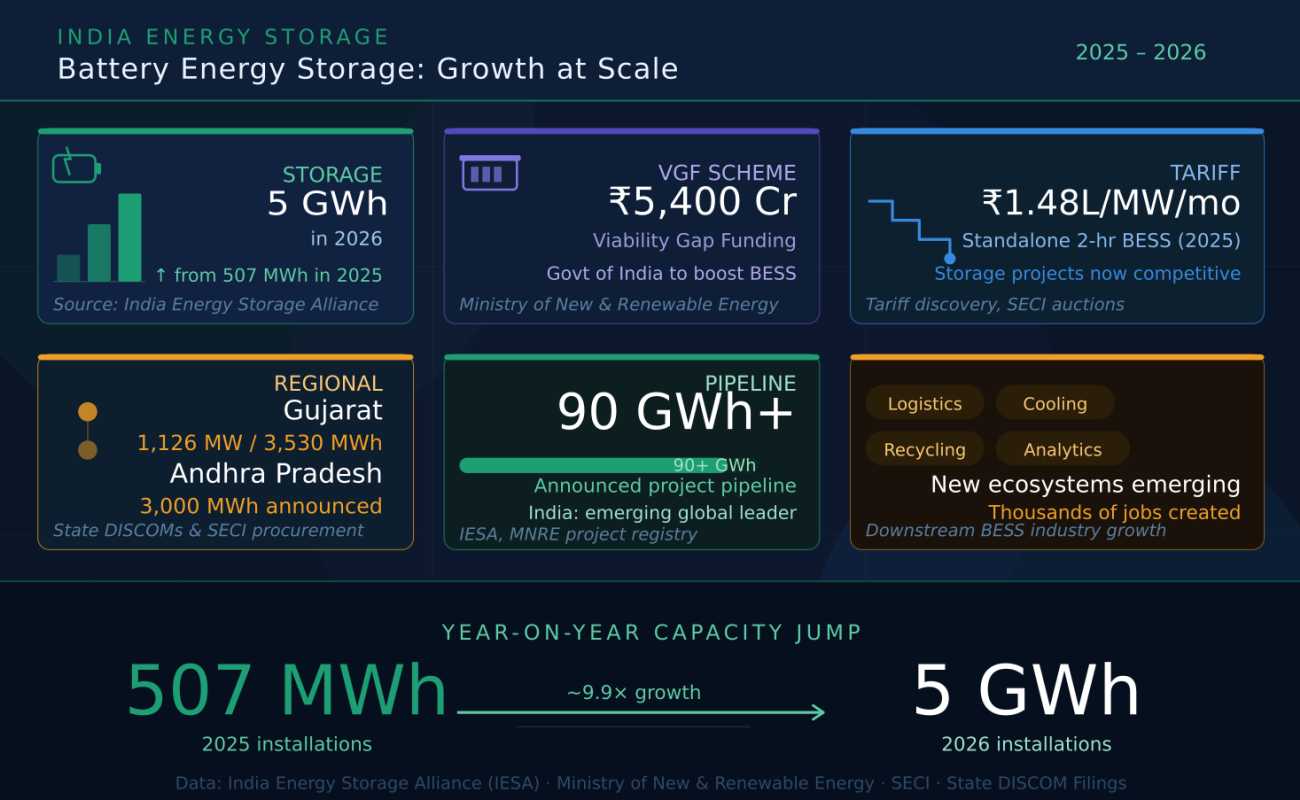
India's Grid-Scale Storage Revolution 2026